Showing posts with label History. Show all posts

Saturday, June 24, 2023

 
The world is a strange place, and the human beings that people it make it even more so in a way that nature has little control over. The reverse of humanity having little control over nature. Which is as it should be, for the most part. There's an article in the paper today, that the Economist, in presenting its latest findings on the livability of the world's great cities has given Vienna, Austria, top billing. Judged by the standards of health care, education, stability, culture, infrastructure and the environment.
 
Jews had a prominent place in Vienna's culture, as philanthropists and collectors of art, along with their role as leaders in medicine and science. Vienna now boasts its pride in Sigmund Freud, but in 1938 when the Anschluss was declared, Austria opened its arms to German domination and enacted laws disentitling Jews of their citizenship blocking them from academia, purloining their property and sending them into exile.
 
Cheering crowds greet Hitler as he enters Vienna. [LCID: 70065]

A cheering crowd greets Adolf Hitler as he enters Vienna. Austria, March 1938. USHMM

Kurt Waldheim, a politician and diplomat who eventually became chancellor of Austria, was a member of the Hitler Youth movement (National Socialist German Students' League), and was involved in war crimes. Before becoming Austrian chancellor, he was elected by the United Nations general body to become UN Secretary-General in 1972.

The world is always in crisis of one kind or another, be it a natural phenomenon whose origins have nothing to do with the machinations of humanity; floods, tornadoes, volcanic eruptions, earthquakes, wildfires; an inferno of never-ending calamities. The major cause of human disruptions, however, remain human actions, where world wars break out, and smaller, deadly conflicts follow. From places in the world as diverse as Darfur, Sudan, to Syria and Ukraine, territorial ambitions and ruthless leaders set the pace.

All of this to say how fortune we are -- we and most of the world's population -- not to have intimately and directly suffered the effects of these dire situations. Aside from the very real fact that we live with the indelible shadow of a collective memory of what humanity is capable of, and mourn the loss of distant relatives who never were given the grace of a future. 
 
Living in security and comfort as we do, we also know that the world is ever in flux, slowly changing around us. What we have assumed to be a permanent way of life, a history and culture that has been stable for generations is changing.

This knowledge doesn't hamper our enjoyment of life in the present. We go about our daily lives, little impacted by the news we read daily out of the rest of the world. A world where migratory aspirations have since time immemorial seen humans arriving on shores not their own, to become their own, eventually changing the face of humanity and the environment it makes its own.
 

Today, our little family enjoyed another hot and humid summer day, the air scrubbed fresh by an all-night rain that brightened the colours of all that surrounds us. A humid day, thick with moisture and warmed by the sun. Where inconsequential little things take our attention. A sudden inclination, looking about the house, to decide to move around paintings hanging on the wall; for a new perspective.
 

An urge, despite the heat, to move about the garden beds in wonder that nature's vegetation is so responsive to its environment that daily there are new surprises. And there is never a lack of pampering the gardens, just to attend to the odd little adjustment here and there, treating the plants just as we do the paintings in the house interior. So snip off old blooms to make way for new ones, tie up wandering tendrils of vines, prop up the long slender spears of lilies with restraints to keep them from falling gracefully from garden to lawn.
 

Above all, look to the exhortations of two little puppies who are certain that the hours of the day are passing too swiftly and when will they ever be given the opportunity to strut along the forest pathways sniffing out intriguing odours, discovering the presence of unrecalled items of curiosity, reminding us they haven't yet had their cookie treats, greeting their friends as they appear in expectation of cookie handouts.

These are the plentifully serene and worthwhile episodes in life that no one should be denied.


Friday, April 22, 2022

Sacrilege

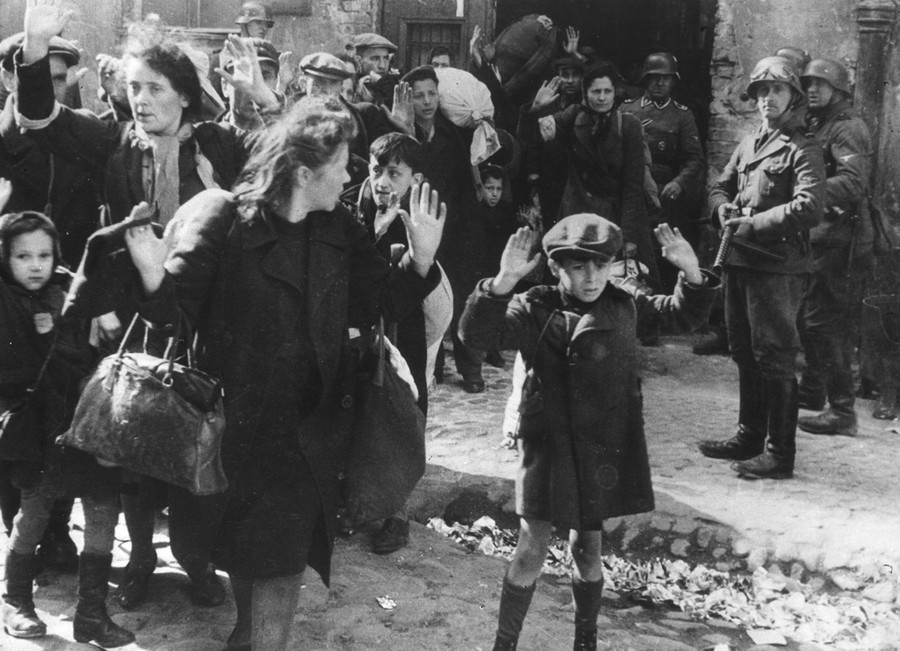
A group of Jews, including a small boy, is escorted from the Warsaw Ghetto by German soldiers in this April 19, 1943 photo. The picture formed part of a report from SS Gen. Stroop to his Commanding Officer, and was introduced as evidence to the War Crimes trials in Nuremberg in 1945

To Jews, ever mindful of Jewish history and a never-ending plague of assaults on their presence by communities wherever diaspora Jews have put down alternate roots, after their second expulsion from Judea, their ancestral homeland in the Middle East, the Holocaust represents an unspeakable atrocity committed by Nazi Germany with the considerable assistance of eastern and western Europe and the determined oblivious attitude of the West in general to their plight. 
 
When Jews repeat in their minds 'never again' it means that they will do their utmost personally to fight back against the persecution and defamation they are endlessly subjected to. 'Fighting back' is a passion expressed in the struggle for survival. Slights, born of an inbred, taught and sought discrimination  expressed against the Jewish presence has a habit of becoming socially institutionalized. It ebbs and flows, like the oceans surrounding continents.
 
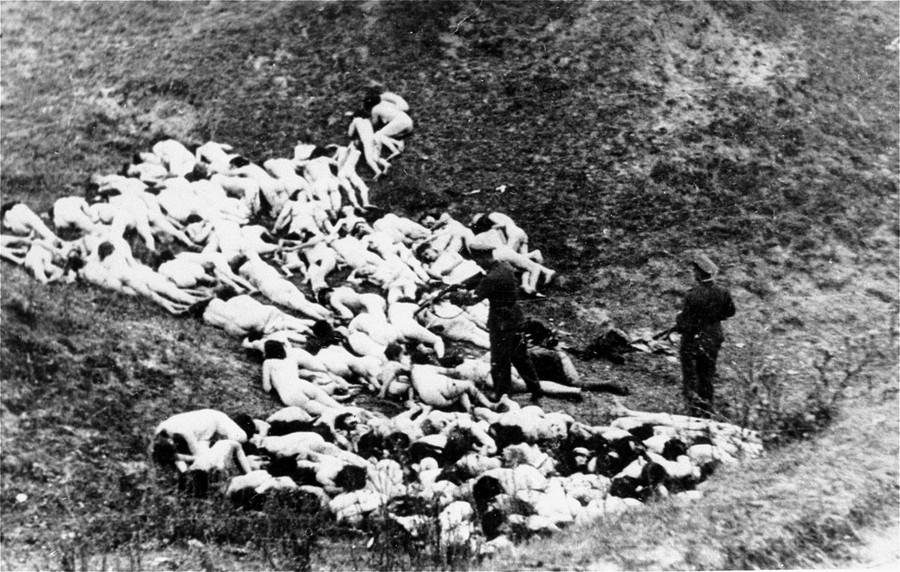
A German in a military uniform shoots at a Jewish woman after a mass execution in Mizocz, Ukraine. In October of 1942, the 1,700 people in the Mizocz ghetto fought with Ukrainian auxiliaries and German policemen who had intended to liquidate the population. About half the residents were able to flee or hide during the confusion before the uprising was finally put down. The captured survivors were taken to a ravine and shot. Photo provided by Paris' Holocaust Memorial
 
And whatever continent Jews happen to populate, a minority group within much larger groups, they are always 'noticed' as outsiders. With that notice comes a degree of suspicion. A suspicion often a nudge away from contempt and hatred. For within the larger population there are always those whose antipathy toward Jews -- even and particularly if those haters know nothing about Jews, do not know any individual Jews, have never met Jews -- twists them toward rage against Jews.
 
There are Holocaust memorials erected in various geographies across the world, in a determined effort never to forget the stark inhumanity that humans are capable of exerting against other humans. Where governments and individuals embrace the opportunity to learn and to empathize, committed to ensuring as believers in elementary human rights that nothing of this dread magnitude will ever re-occur. And yet, on a smaller, and equally inexcusable scale, they do, and each time they do humanity is shamed and shocked anew.
 
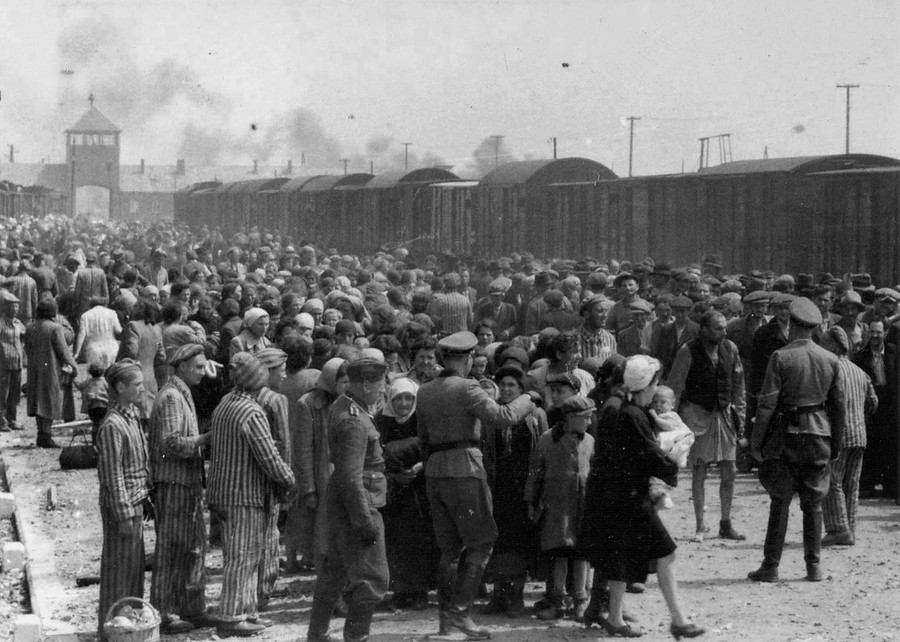
The arrival and processing of an entire transport of Jews from Carpatho-Ruthenia, a region annexed in 1939 to Hungary from Czechoslovakia, at Auschwitz-Birkenau extermination camp in Poland, in May of 1944. The picture was donated to Yad Vashem in 1980 by Lili Jacob
 
Start small? With ignorance about the fact that a fascist horde schemed to annihilate the entire Jewish population of Europe, on its way to conquering the world for Aryan purity. That the organized industrial-scale mass murder succeeded to the degree that an estimated six million Jews were systematically slaughtered. The corpses were used to produce soap and fertilizer. Children and adults alike fed into death chambers where Zyklon B, a cyanide-based pesticide, killed them, and their bodies were shovelled into vast, non-stop crematoria. The odour of burning flesh and the ash circulating as particulate matter lifted by the smoke exuded by the giant chimneys to fertilize the fields of Europe. 

National Holocaust Monument
Canada was late to erecting a memorial to the Holocaust; but one was finally built and opened to the public in 2017. On a number of occasions, the stark, grey angular walls of mourning attracted professional photographers on fashion shoots, as likely backgrounds to show off glamorous designer apparel featuring poised, sleek female models. The photographers in each instance appear not to have known, or really gave no thought to the fact that their commercial enterprise in artistry and mercantilism in a place sacred to the memory of millions of people was an assault on social morality and values.

In the latest of these events, the photographer was scathing in his response to criticism over his obtuse choice of backdrop for a photo shoot:
"If taking a photo with grey walls as a backdrop is a crime, lock me up."
"If you don't want people shooting at certain walls in the city, you should put on a reflective vest, get a whistle and go stand in front of them year 'round."

Thursday, August 19, 2021

My bedtime reading has been consumed lately by Flavius Josephus's book, The Jewish War, though I do feel the word 'war' should have been plural. He left it singular despite documenting a myriad of conflicts both among various Jewish tribes throughout antiquity and their neighbours, but he meant to focus on Judea under Rome's Imperial Rule. Jews are always held to be a stiff-necked people; they are at present and were back in an ancient era when Roman legionary occupation of most of the known world was a reality.

The Roman Empire stretched from Europe to North Africa and Western Asia and beyond, its disciplined conflict-seasoned military constantly busy putting down insurrections wherever people of other countries felt their value as national patriots was demeaned by being forced to give their devotion to a foreign empire. Josephus was one of those devout nationalists, Judea his pride and focus. As a general he was given the role of administrator of the Galilee.

 As administrator, while Jewish religious and political functionaries plotted an uprising against Rome, he ordered battlements to be constructed around Galilean towns to attempt to make them impervious to military conquest. Many of the towns were situated on or beside mountain slopes, giving them natural barricades against enemy ingress beyond the steep walls and towers erected to defend the towns.

One of the largest of which was Jotapata and which Josephus took personal control of, when Vespasian, an elite general in command of countless brigades (horse and foot) and his son Titus were dispatched by Caesar to put down the Judean insurrection. Josephus's account of himself as commander, referring to himself in the third person is full of praise for his own acumen, skill and daring. He describes in excruciating detail the siege that encircled Jotapata with the brute force the Romans could exert with their gigantic slings and battering rams, and his resourcefulness in strategic defence against the invaders.

And while tens of thousands of Jews of all ages were slaughtered by the Roman legions as towns fell one after another, he managed to find it in himself to praise Vespasian and Titus and the 'generosity of spirit' and 'kindness' of Rome, in sparing his own life through admiration of the exploits of a seasoned and clever defense stratagist. Gripping and self-serving, but also, through his writing and observations and descriptions handing down for posterity a detailed account of an ancient episode in history.

As for our present era, we've more than enough of barbaric episodes of conflict; the one unfolding now in Afghanistan a dire case in point, where an oppressed people whose nation has seen more than enough strife through the ages, is once again in the grip of a medieval-era theocracy for which savage administration of the affairs of the nation in the interests of obeisance to the strictures of a religion all too often interpreted to detract from quality of life in favour of quality of death, reminds us that not much has changed in human nature.

None of which is known to Jackie and Jillie to trouble their little canine minds happy to be in our company, focused on food sources and the comforts they have become accustomed to in their daily lives, one of which is their daily visit to the forest trails in our nearby ravine. This morning they were out early again with the assurance the woods would still be overnight-cool, the heat of the afternoon not yet penetrating.

Others in the wider community had the same brilliant thought, so this was not one of those long circuits that we sometimes experience, seeing no one else at all out on the trails, neither people nor their companion animals. For the first half of our circuit we kept bumping into others of our acquaintance and of Jackie's and Jillie's, a kind of happy free-for-all encounter with some trails becoming quite crowded with the happenstance presence of people and dogs.

A vast world apart from the era of the Roman Empire, of national disasters where many countries are bled by one belligerent, proud country that views itself as the natural and sole authority to reign over all.


Thursday, January 28, 2021


We tend to think of ourselves as experiencing something entirely new, struck by a global pandemic. It has certainly altered the way we live beyond anything our reluctant imaginations could ever conjure. If -- and it isn't likely -- we ever paused in our busy lives, to consider what such a catastrophe enveloping the world as we know it might turn out. Despite that from time to time we've read warnings issued by world-renowned epidemiologists who have been preparing for years for such an inconceivable event. Inconceivable to us, entirely and rationally conceivable to them.

Until with seemingly lightning-speed a new coronavirus presented itself, and we read with little interest that something new that produced a pneumonia-like effect in its victims had emerged somewhere far off in China. Where it had no intention of remaining and began to travel widely, like a seasoned traveller determined to circle the globe. It did, and we've been in various states of lockdown, mourning and fearful suspense ever since.

So it's beyond interesting to read in the most current book you're absorbed in, a historical account that resonates, reminding that the world has always been challenged by such events.

"As there were few European-trained doctors or surgeons in Quito, the Frenchmen's services would have been in great demand. Accompanied by their friend, the emigre French doctor Raimundo Dablanc (who, back in 1736, had loaned money to the expedition to carry out its initial geodesic surveys), they would likely have made the rounds dressed in the peaked hats, red coats, silver-buckled shoes, and blue pano asul capes that marked the local doctors as distinctively as their gold-handled walking sticks. The men certainly did not lack for work, as the church-run hospitals were frequently overcrowded, understaffed, and in disrepair. Sickness and death were constant neighbours in the eighteenth century, wherever one found oneself; child mortality rates in 'backwards' Peru were actually little different from those in 'advanced' Europe. On both continents, parents knew that one in four newborns would die in the first year, and half their children would not live to adulthood. The anguish of loss was not diminished by this knowledge, and neighbourhoods in both Europe and the Americas regularly resounded with the keening of bereaved mothers and fathers."

"Infectious diseases were the primary cause of this suffering. In the eighteenth century, they raced around the world in epidemic cycles, borne between Europe and remote regions such as Peru by caravans and ships carrying goods throughout the already globalized economy. None of the dozen or so great killers -- including measles, yellow fever, smallpox, malaria and diphtheria -- originated in South America. Many of these diseases incubate in domesticated herd animals (pigs especially) that live in close proximity to humans, whereas for much of their history the Indians had only guinea pigs and Llamas, which made for bad hosts. The diseases came with the first conquistadores and quickly spread far beyond their original contact with the indigenous peoples of the Americas, devastating their populations long before most of the victims ever saw a European. Smallpox, for example, likely killed off much of the Inca population in the late 1520s, including its great ruler Huayna Capac, leaving his kingdom in disarray and making it easy pickings for Pizarro and his conquistadores when they arrived just a few years later."

"By the beginning of the 1600s, the Indian populations around Quito had been cut down by almost 90 percent and was rebounding only very slowly. Every decade or so another epidemic laid the population low; the last great epidemic of 1718-1723 most likely influenza, destroyed a quarter of the Indian population in Peru before extinguishing itself."*

It's been cold today -- we're heading back to colder temperatures. When we were out in the ravine this afternoon it was -10C, and steadily falling, with a sharp, gusting wind, partially overcast with occasional glimpses of sun. For the next few days it will be progressively colder, though still not yet in -20 territory, so we can be grateful for that, at the very least.

Jackie and Jillie seem impervious to the cold, as long as they're trussed in their sweater, coat and harness, in that order. For the first half of our circuit we found few people about, but soon we came acounter groups, one with five preteens who took whooping turns taking running leaps onto their backsides to slide down the hillside trails, having the time of their lives. Their dogs running happily alongside the snow-gliding children.


Wednesday, August 26, 2020


We slept in this morning to an unheard-of 9:30. And awoke only then because Jackie and Jillie were nudging us awake. Small they may be and delicate-featured, but when you're in repose and they inadvertently happen to step on you, there's more than enough physical pressure to influence your lazy eyes to open as you groggily acknowledge their presence.

Which meant that we were late setting off with them this morning on our usual early morning ravine hike. They were pretty cheerful about it, in contrast to our slight ill humour. Truth is, Jackie awoke us at 4:30 a.m. once again, having to be let out to the backyard. Second night in a row. Disturbed sleep doesn't make for the best of bedfellows.


But if we  hadn't set out so late we'd never have come across our old friends Rod and Nova. Nova takes Rod out to the ravine three times a day. He's a bundle of energy, a white German Shepherd who loves people and evidently coyotes, as well. Jackie and Jillie have known Nova since they were all three puppies. Rod was out for his second turn in the ravine this morning. He's taking shorter circuits this past year, finding the ascents and descents a little demanding. Nova, on the other hand, looks for distractions and is off and about here and there in the forest interior.


She plays with the coyotes, they indulge in little chase-abouts, it would seem, and  have for quite a while. Rod told us that because he sets out just after six every morning he frequently sees coyotes. Last week on two occasions he saw and  heard a coyote close to where he stood, yipping. He finally deduced that it was alerting another coyote to the presence of people (him). They were protecting coyote pups in a nearby den.


Hard to say how many coyotes the forest accommodates now, whether there's a full pack, a family group whose territory it has become. But we're agreed that the coyotes pose no threat unless they're challenged by dogs chasing after them. And Nova doesn't chase after them, he chases with them for a frolic. Rod told us he watched recently while they ran after one another, Nova and a coyote, up and down one of the hills, five times in quick succession before Nova rejoined him.


Jackie and Jillie are not socially inclined in that manner. They tend to behave aggressively when confronted by a dog they're not familiar with. And we know their reaction on coming across a coyote would be to challenge it, first by barking furiously, then by harassing it, leaping about and growling. Two very small dogs threatening a species quite close to them on the evolutionary scale. The coyotes, to protect themselves would respond and we'd stand the chance of losing one or both of our rash little companions. Therefore, the leashes.


For part of our circuit there appeared quite a few other ravine hikers we've known over the years, but as we ventured further within the forest, their number declined to the point where the last half of our circuit was serene and quiet, none others around -- man nor beast -- but for ourselves. The forest was drying out nicely from the past several weeks of ongoing rain events; no more puddles on the trails, no more glittering drops on the vegetation.


We ambled on past our last ascent to street level, bypassing it to extend our hike just a little further, wanting to see how the wildflowers that grow in some abundance in a forest clearing had coped with the rain. And were rewarded with the sight of large colourful clumps of goldenrod, a few lagging groups of fleabane, clover in flower, plenty of pilotweed still flowering, a few purple loosestrife, Himalayan orchids, and the creme de la creme, black-eyed Susans.


Tuesday, July 28, 2020

Excerpt, Richard Hakluyt Voyages and Discoveries : 1589

Voyages and Discoveries : Hakluyt : The Principal Navigations Voyages, Traffiques and Discoveries of the English Nation

A discourse written by one Miles Philips Englishman
put on shore in t he West Indies by Mr. John Hawkins
1568

Image result for hakluyt voyages and discoveries published
Upon Monday the second of October 1457 the weather being reasonable fair, our general Mr.John Hawkins, having commanded all his captains and masters to be in readiness to make sail with him, he himself being embarked in the Jesus, hoisted sail, and departed from Plymouth upon his intended voyage for the parts of Africa, and America, being accompanied with five other sail of ships, as namely the Minion, the William and John, the Judith, in whom was captain Mr.Francis Drake afterwards knight, the Angel, and the Swallow.

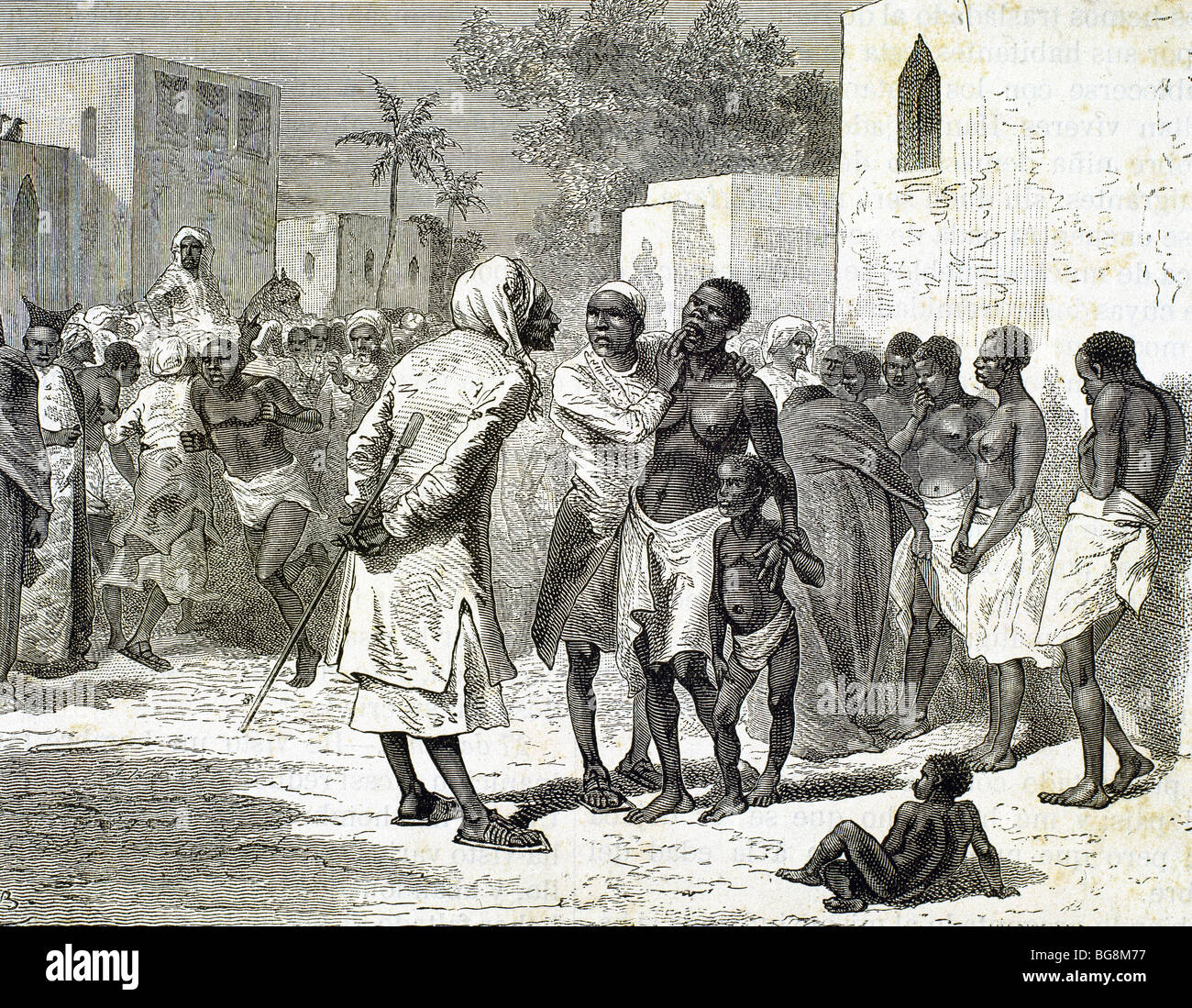
Coming to the Island of Gomera being one of the islands of the Canaries, where according to an order before appointed, we met with all our ships which were before dispersed, we than took fresh water and upon the eighteenth day of the same month we came to an anchor upon the coast of Africa, at Cape Verde in twelve fathom water; and  here our general landed certain of our men, to the number of 160 or thereabout, seeking to take some negroes. And they going up into the country for the space of six miles, were encountered with a great number of the negroes : who with their envenomed arrows did hurt a great number of our men, so that they were enforced to retire to the ships, in which conflict they recovered but a few negroes, and of our men there died seven or eight in very strange manner, with their mouths shut, so that we were forced to put sticks into their mouths to keep them open.

Upon the coast of Guinea, we obtained 150 negroes. There was a negro sent as an ambassador to our general, from a king of the negroes, which was oppressed with other kings his bordering neighbours, desiring our general to grant him succour and aid against those his enemies, which our general granted unto, and went himself in person a land, with the number of two hundred of our men, and the king which had requested our aid, did join his force with ours, so that thereby our general assaulted, and set fire upon a town in which there was at least the number of eight or ten thousand negroes, and they perceiving that they were not able to make any resistance sought by flight to save themselves, in which their flight there were taken prisoners to the number of eight or nine hundred, which our general ought  to have had for his share : howbeit the negro king falsifying his word and promise, secretly in the night conveyed himself away with as many prisoners as he had in his custody : but our general notwithstanding finding himself to have now very near the number of 500 negroes thought it best to depart with them, and such merchandise as he had from the coast of Africa, towards the West Indies and therefore commanded with all diligence to take in fresh water and fuel, and so with speed to prepare to depart. In a storm we lost one of our ships the William and John, of which ship and of her people, we heard no tidings.

Slave Market High Resolution Stock Photography and Images - Alamy

*************************************

Sunday, April 19, 2020

According to statistics available from the Jewish Virtual Library online, in 1939, the year World War Two broke out, there was a total of 16,728,000 Jews across the globe. By 1945, following the Holocaust years and the end of the War when Allied powers defeated the Axis powers headed by Nazi Germany, there were 11,000,000 Jews left world wide, after their mass extermination by the Third Reich throughout the war years. Latest figures for 2018, give a world Jewish total population of 14,606,000. Clearly a complete recovery of numbers has not yet been realized a full 75 years later.

My father and mother arrived in Canada in the mid-1920. My father's passage had been arranged by a philanthropic organization that had picked him and other young Jewish boys off the streets of Warsaw where they lived as orphans and runaways from pogroms. My father, arrived in Warsaw from a much smaller town, called a 'shtetel' when, at age 13, his parents both died and he was placed in a poor house operated as a charity by the locals. He ran away to Warsaw in search of his older brother. He failed to find that brother, and began living on the street. And like the other children he became an indentured farmhand in Canada until the years passed and he was able to pay off his debt, and was freed to assume a normal life.

My mother and her older sisters emigrated from the Pale of Settlement during the time of the Russian Revolution. They managed to leave that zone that encompassed parts of  Ukraine, Latvia and Poland, multi-lingual, oppressed and discriminated against thanks to a loan given them by an extended family member who had earlier emigrated to the United States and was comfortably settled there. At that time it was easier to enter Canada than the United States, although during the war years few countries opened their borders to Jews desperate to escape an inevitable fate.

I was three years old when the war began, and nine when it ended. I knew I was different than other children because other children didn't have to experience being accused of being a 'Christ killer'. Other children had grandparents while I had none. I had questions, some of which my parents responded to, and others which never left my lips. I knew that Jews lacked popularity in society and despite that unlike a child crying in a locker room that I dimly recall from my early school years, never wished to be other than a Jew.

I overheard my parents discussing the plight of European Jews in whispered tones of panic that disturbed me, but questions respecting that subject were not entertained as unfit subjects of conversations with children. But I could read, and occasionally came across papers in my father's possession alluding to claims of mass murder, a concept well beyond my understanding, but leaving me with a fearful hunted feeling that haunted me, and left me with the feeling that I must always be on guard.

As I grew older, I read accounts of the Holocaust constantly. Historical accounts and personal accounts. I wanted to know every possible detail. While of course reading much earlier accounts, almost from the dawn of history of the Jewish struggle to overcome adversity, the hatred, suspicion and violence accorded their presence throughout the world, through the ages. And then, this, as good an ecapsulation as any of the experience of a then-young girl who survived Auschwitz:

Witness To Genocide : Margit Buchhalter Feldman

"Margit [Buchhalter Feldman] devoted her life to telling her inspiring story and touched the hearts of thousands of students, educators and members of the community."
"Her goal was to inspire people to stand up for one another and fight against all forms of prejudice and hate."
Obituary, Margit Buchhalter Feldman, 90, Somerset, New Jersey, COVID victim
Holocaust survivor Margit Buchhalter Feldman, 90, died Tuesday of 
the coronavirus.
Holocaust survivor Margit Buchhalter Feldman, 90, died the coronavirus. (Twitter)

"It is important for me to remember that 6 million of my fellow Jews were slaughtered, and a million and a half of those victims were children."
"I am here and I firmly believe it is because God wanted me to survive and be here and tell the free world what an uncaring world did to its fellow human beings."
"You were put into a barrack, where people died. The straw that you laid down [on] was full of whatever came out of their bodies -- vomit or excretions. It didn't take 24 hours for your body to get covered with lice."

"I rose from the ashes of Auschwitz, Krakow, Greentsery, Bergen-Belsen as a child of 15 years of age from the Holocaust to rebirth and a new life."
Margit Buchhalter Feldman
"Her legacy is best captured in her work to ensure that the world never forgets the horrors of the Holocaust."
"Margit gave us so much hope over her 90-plus years."
New Jersey Governor Phil Murphy

"She was just an extraordinary human being, to have lived through all that, to have lived that life and to have suffered through those camps, yet to be grateful for life, to see the promise of tomorrow, she was just such an exceptional person."
"After living through that hell, she was blessed with the gift of authenticity. She lived fearlessly and she loved fearlessly."
"It's like there was nothing that the world could do that would cause Margit to live anything less than with full authenticity and the full measure of her being."
Jim McGreevey, former Democratic State Assemblyman, former New Jersey Governor 
A photo dated April 1945 of women prisoners of the Bergen-Belsen concentration camp gathering dead fellow inmates before burying them. BRITISH ARMY HANDOUT

This courageous woman who defied the intention of the Third Reich to slaughter her as they had done her close and extended family, her parents and her relatives, lived to make a full life for herself, to raise a family of her own and to become a valued member of the society in which she lived. She was born in June of 1929 in Budapest as an only child. She and her family were forced to leave their home in the agricultural town of Tolcsva, all that they owned no longer theirs. Imprisoned nearby temporarily, then shipped off to Auschwitz.
There she no longer was to know herself as Margit Buchhalter, but A23029, the tattooed number burnt into her flesh as a concentration camp inmate destined for extermination. She was only fifteen, but passed herself off as 18, a life-saving decision on her part, which ensured she would be sent to slave labour camps before being sent to a death camp. She recalled "big heaps and mounds of dead bodies laying all around", as people died of hunger, exhaustion and disease, during her time as a forced labourer.

She was liberated on April 15, 1945, alone and deathly ill, suffering from pneumonia and pleurisy, seriously injured as well, when the Germans attempted to destroy the camp with the use of explosives. She was nursed back to health in Sweden, recovered, and chose to move to the United States in 1947 where she was received an education as an X-Ray technician. Her work led her to meet her future husband who was recovering from tuberculosis, at a hospital in New York.

She and Harvey Feldman married in 1953 and raised two children together, who eventually gave them three grandchildren. On Tuesday, Margit Buchhalter Feldman died of the effects of COVID-19. Her husband Harvey remains hospitalized with the novel coronavirus. Their son is now a doctor, and he works on the front lines of the New Jersey pandemic where over 75,000 confirmed cases of coronavirus have been identified, causing over 3,500 deaths.

Although this Holocaust survivor spoke nothing of her painfully wrenching experiences for many years, there was an occasion when she had agreed to speak to young students in her Bound Brook, New Jersey neighbourhood whom she introduced to the unspeakable catastrophe that had befallen  her family of 70 related Jews, and of her incarceration in a number of concentration camps as a slave labourer. The children's reaction inspired her to continue her work as a witness to genocide.

In 1991 the-then state assemblyman Jim McGreevey collaborated with this survivor to promote Holocaust Education in New Jersey through the formation of a special commission. She went on to help pass a bill mandating a Holocaust and genocide curriculum in public schools in the state, while speaking to classrooms of children for years, and finally releasing a 2003 book detailing her life as a teenage survivor: "Margit: A Teenager's Journey Through the Holocaust and Beyond".

Holocaust
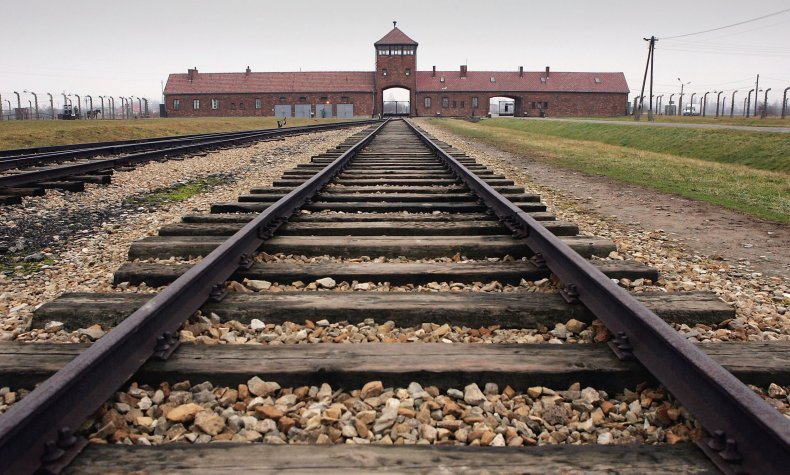
The railway tracks leading to the main gates at Auschwitz II - Birkenau Scott Barbour/Getty


Sunday, March 31, 2019


We had an intimation of what the day would allow us to do and what it would not be feasible for us to plan when we walked down the steps from our second floor to the first, glanced out the glassed front door and saw snow falling. We had no idea how long it had been snowing, but the fresh snow nicely covered the season's snowpack that had begun melting, freshening it beautifully.

We had to do the usual mental shrug of acceptance of the inevitable with March even if this was the penultimate day and March had been given ample opportunity earlier in its winter reign to wreak havoc on the landscape. Never satisfied, March always has more in store, and was unleashing that 'more' yesterday. When we were having our breakfast, looking out the patio doors we could see that the snow had intensified, falling in great fluffy gobs. Beautiful to behold, especially if it had been January, but the end of March?


No matter, down it came. But by noon it was over. Instead what had fallen as snow began coming down as freezing rain. Sleet is, for our purposes, less amenable than snow. No one in their right mind with two little dogs plans to head out to a forest for a leisurely hike along the ravined trails in pouring rain in a season that resents leaving in favour of spring's entrance.

The rain continued into the afternoon. Which meant no ravine walk. By that time I had decided that it was past time to begin what I had been putting off. Similarly, when looking out of the house onto a decidedly wintry landscape, our gardens deep in snow, the urge to begin spring cleaning just isn't there. Not that the prospect of indulging in days and days of cleaning out cupboards is anyone's idea of a particularly pleasant pastime...it's just one of those things you do. And so I began.


The pantry in the kitchen was my first target. It's a must-do, to take stock as an example, and get rid of things you can dispense with. I wrapped quite a few items in newspapers to take along to the Sally Ann recycling depot; glass vases, glass juice containers that I hadn't used in ages and likely never would again; small glass dispensers, extraneous baking dishes. And in that portion of the pantry where baking supplies, canned foods, jams, are kept some order was required and assessment of what was there and what might be outdated. It's a start.


From time to time one of us would initiate a bit of play through the day with Jackie and Jillie, to throw around tennis balls or knotted mittens that they much prefer to play with, to get them going until they felt like independently playing and tussling about with one another. Jillie is more of a snoozer, while her brother enjoys standing at the front door, barking and harassing the squirrels coming by for treats laid out on the porch.


In the evening, we watched three segments of a British Masterpiece Theatre series called Indian Summers; a fascinating drama focusing on the dying days of the British Raj. No other cinematic entities can beat British cinema at depicting itself as an arrogant, entitled occupier of a foreign land under the self-appointed task of relieving developing countries of their natural resources, in the process leaving them with the inestimable riches of British jurisprudence, bureaucracy, snobbery and cricket.

Theirs was in some ways an issue of noblesse oblige; viewing themselves as altruistically dedicated to the advancement of civilization to countries whose civilization long predated Britain's, endowing those countries with the indelible stamp of British colonialist rule. They viewed themselves as benevolent in their dictation to others what they should value and how they should behave.

Coincidentally, last night I finished reading 7 Years in Tibet, a fascinating first-hand account that described another Asian nation under colonial duress by a powerful neighbour whose outreach in the interests of territorial expansion was not resistible by a much smaller, less warlike nation of Buddhists. No one could ever accuse the Chinese of being guilty of benevolence toward others.

Sunday, December 23, 2018

One of the print newspapers we read daily in our home featured a Nativity-themed stained glass window that a Quebec church commissioned following the Second World War. It is a work of art that was designed and executed by an Italian immigrant to Canada. A trained artist with an extensive art background in Europe, he came to Canada to study under a widely-respected Italian master-craftsman known for the quality of his stained glass murals.

When the Second World War broke out the government of the day in Canada decided that some Canadian citizens of European and Japanese extraction were not merely Canadians like any other but in fact "enemy aliens" and decided to assemble them and intern them in what can only be referred to as 'prisoner-of-war detection camps', in some instances incarcerating whole families, in others separating men from their families, leaving women and children destitute, confiscating properties as due punishment and humiliating Canadian citizens for no other reason than their ethnic heritage. This, in a country built on immigration from all corners of the world.

Image result for church stained glass, vincenzo poggi
Vitrail de Vincenzo Poggi Stained glass
The windows that this man, Vincenzo Poggi, produced, are acknowledged for their beauty, colour and vivacious vision of humanity and religious devotion. After his release from the 'concentration camp' that he and his fellows were confined in for the duration of the war, he quietly resumed a normal life in Canada, never addressed the period in his life when he was under suspicion and confined from general society, and took up once again his profession as an artist.

He is long dead; his art endures. And so does Canada's shame.

When I was a child I recall visiting a house next to where my parents rented an upstairs flat in another house on Manning Avenue in Toronto. There, an Italian family lived. It was where I was first confronted with the magic of a Christmas tree in full-lit splendour. It was where I saw an old, very old woman in a rocking chair knitting, knitting, knitting. She was aiding the Canadian war effort, knitting copious numbers of khaki-wool caps, mittens and scarves. Beside her was a large carboard box filled to overflowing with her product.

As a Jewish child I was mesmerized by the fantasy of Christmas exemplified by the gorgeously-dressed automatons in Christmas scenes that blazed in full light and colour and action in store-front windows of department stores like Eaton's and Simpson's. Those stores devoted several floors in their retail businesses to displays of Christmas in vintage form, replete with angels, Santa-elf-helpers, endless snowy Christmas landscapes and lavishly-festooned trees. It was a winter wonderland of the highest, imaginatively creative order.

I never sat on Santa's lap, but our three children did once, when they were young, all three grouped around Santa, the youngest on his lap.

Famously, during the First World War, German and French combatants came out of their trenches in a shared moment of Christmas nostalgia and goodwill, to celebrate Christmas together for that one, singualr day. In Canada, during the Second World War, Canadian citizens deemed 'enemy aliens' languished in concentration camps on Christmas Day.

Image result for church stained glass, vincenzo poggi Vitrail de Vincenzo Poggi Stained glass

Friday, April 13, 2018

"I dig out my Canada map and scan the country to the east. A few hundred miles away, on the Mackenzie River, I spot Fort Simpson. Now I'm more than pleased that I loaded extra fuel at Tagish Air. After crossing the Mackenzie Mountains, I'll intercept Canada's "Grand Canyon" of the South Nahanni River and land at Virginia Falls, a 315-foot-high spectacle that eclipses Niagara Falls. Perhaps I'll stop at Glacier Lake, a wilderness rival of Banff's Lake Louise, or, if the weather holds, camp beside a lovely beach at Little Doctor Lake."
"The Cub climbs at full throttle toward the peaks of the Selwyn Range, where I cross the Continental Divide and return to the Northwest Territories. In dreamlike serenity, the Cub floats past 9,000-foot Mount Sir James MacBrien, soaring above sculpted snow fields as pristine as those of the Coastal Range until a glittering finger of water at Mount MacBrien's base finally slips into sight. I throttle back, letting the Cub slalom down to Glacier Lake, the crown jewel of the Ragged Range. S-turning through sweeping turns, the Cub and I descend through valley-cradled air."
"As I coast to a stop beside a placid stream at the edge of a quiet beach, a stellar jay flits toward the mountain's vertical face. My eyes follow the jay, then climb six thousand feet of glistening rock to the pinnacles far above. At the foot of the mountain, a meadow bathes in sunlight, green and soft as a fantasy."
"Spotting an odd-looking object protruding from the reeds, I remove my boots and socks, and wade through the frigid water toward what becomes a set of moose antlers. I'd love to take t hem home, but they'd never fit in the Cub, and they'd raise aerodynamic havoc if I strapped them to the floats. Still, I can't ignore such a find, so I haul the antlers back to camp and hoist them onto the Cub for a unique photograph. Backed by MacBrien's towering columns, the yellow Cub gleams at the edge of a sparkling stream, sporting a dark brown moose-antler hood ornament."
..."Immersed in mountain silence, I stand at the end of the float, trout in hand as a majestic array of snow-capped peaks spreads mirror images across the lake's opalescent green. At the head of the lake, the highest peak in the Territories guards the Cirque of the Unclimbables, an amphitheater of vertical faces that are sought by skilled climbers from around the world. Surrounded by such Macchu Picchu-like beauty, I understand why so many native Americans honoured the land and rejected the white man's heaven."
"An appallingly thin lynx walks into camp in the midst of my supper. Long-legged, with big feet and pointed Spock-like ears, the lynx strolls calmly past, not far from my hissing stove. It must be aware of me, but the scruffy animal hardly gives me a glance. Perhaps it had just passed through the depths of the endless ten-year-long boom-and-bust cycle of hare and lynx populations, and it isn't about to let pointless distractions sap its strength."

Sometimes you read a book that so entrances you with the quality of its observations, its setting descriptions and the lyrical quality of the writing, you feel you know the person intimately who is writing his account of a solo months' long trip to the Canadian Arctic. Minnesotan George Erickson, a retired dentist and amateur bush pilot who flies a refurbished period Piper Cub loves flying, loves nature, loves wilderness and decided he'd take time to make one last protracted trip.

He sees and experiences all that nature is capable of throwing at him, from forest fires to wild winds, killer whales, muskoxen, caribou and polar bears. He is calm in facing quick-witted decision making, excited about unique exposures to events that he can immediately share with no one else. Casual and practical, his mind and his appreciation of the vast area he traverses from Churchill on Hudson Bay, Chantrey Inlet on the Arctic Sea, Northwest Territories, Coppermine and Yellowknife.

He fills his book with the thoughts that pass his mind, memories of past such excursions with friends, and you are left with the sense that this man in his mature years has planned this trip as one that will cap his adventurous soul with 'complete'. But apart from his wonderfully poetic writing style, he is also a consummate story-teller and an erudite student of history, both ancient and current, taking in philosophy, astronomy, science, biology, human nature and the nature of survival.

I do read quite a lot of such books. Of personal accounts of travel to the Arctic, Antarctica, the Himalayas in period narrative form and through biographies. This American man's passion for the Canadian North and his love of the wilderness, his casual approach to his responsibility to his own security are all impressive, but it is his writing style that is utterly captivating. After reading a book of this calibre it's hard to settle down to successive books because your mind tends to compare writing skills and the capability of another writer to bring you sympathetically into the circle of their thoughts.

I had to put aside two books I started after reading George Erickson's True North, Exploring the Great Canadian Wilderness by Bush Plane published in 2000 by Thomas Allen Publishers. Eventually I picked up another: PaddleNorth, Adventure, Resilience, and Renewal in The Arctic Wild by Jennifer Kingsley, a young woman who set out with five good friends, all athletic like herself, accustomed to handling a canoe under all conditions, and determined to paddle the Arctic's Back River.

Where George Erickson battled ferocious winds, heavy rain, soot-blackened skies from wildfires, Jennifer Kingsley and her crew also faced raging winds, sea ice and wild rapids. They saw grizzlies, came across wolves frequently and saw caribou in their northern wilderness adventure of a lifetime. Her style of writing is also very personal, but with a kind of intense quality to it that speaks of tension, in contrast to Erickson's, with the good-natured quality of a relaxed mind.

And while Kingsley also throws in ample anecdotes of a very personal nature, they have a jarring effect and seem unwelcome, reflecting a kind of bemusement of someone uncertain of themselves. She too brings in historical accounts of the people and places being passed through, all of which give perspective to the time and place but somehow there is a feeling their placement is contrived rather than casual, in comparison to the erudite Erickson.

"Levi and I climbed the banks in silence until we could see unexplored ponds and steams, Lower MacDougall Lake, and the girls' abandoned camp in the distance. Turnaround time. Nothing to report."
"When I finally took my eyes away from the horizon to look down at the hillside below us, I slowly reached for Levi's arm. He looked at me, then followed my eyes. Four wolves were climbing straight toward us, padding easily over angled boulders."
"We stood still at first, mesmerized by the casual rhythm of their gait. Their legs chose each rock blindly yet never missed. Yellow-white twists of fur lifted and dropped with each step; their eyes fixed me in place. They climbed straight for us and showed no sign of stopping until two broke off to our right. Are they flanking us? Levi and I shrank back on our haunches behind a boulder, I unholstered my bear spray -- just in case -- and we waited for the wolves to crest the rise. After a few moments, Levi and I stood up again, but the wolves had vanished. I scrutinized each rock with my binoculars, picking out lichen and cotton grass, but we never saw those wolves again."

Clearly, Kingsley is no slouch in her observational skills and writing abilities. Yet to me there is something almost magical about Erickson's writing skill, his absorbing accounts of his activities, his thoughts and preoccupations. When he casts back to retrieve memories they somehow fit the narrative, whereas I found Kingsley's somewhat jarring. Perhaps a result of revealing a tad too much about her intimate thoughts; no one's concern but her own.


Tuesday, February 20, 2018

At the supermarket earlier today where we do our usual weekly shopping, there was navel oranges from South Africa and Egypt, dates from Iran, figs from Turkey, grapes from South Africa and clementines from Morocco. We usually enjoy oranges, clementines, grapes, dates, and figs. Today, we bought none of them, no dates, no figs, no navel oranges, no grapes, no clementines. These are all produce-exporting countries that express their avowed hostility to Israel, the Jewish state, and some of them threaten its existence as well.


As Jews, we have the freedom in Canada to express our own personal hostility to those who feel the Holocaust, which according to them didn't really exist, and if it did, it didn't kill as many Jews as evidence and history state, and in any event however many Jews were exterminated it simply wasn't enough. So we indulge in our own very personal boycott; one that obviously does no damage to the countries that produce the fruits that we will not eat, but which salves our sense of conscious justice.

It rained throughout the day yesterday, and when we awoke this morning it was still raining. No walk for us and our puppies in the ravine, alas. But by the time I put away all the groceries on our return home from shopping, and pre-prepared a casserole of macaroni, chopped green onions, green peas, canned salmon and a cheese choux for dinner, the rain had petered out.

So off we went into the forest, down into the ravine, for a mind-calming walk-about. A somewhat physically difficult one as it happens, since the snowpack has been both melting and softening, so that every step taken sinks deeply into the snow tamped down on the trails through the forest, and it takes far more energy to hike along under those circumstances. The creek at the bottom of the ravine is full and running furiously; two days of rain will do that.


There was a light foggy mist rising from the creek, giving a somewhat opaque albeit sheer look to the atmosphere. Jackie and Jillie were happy as always to be out in the forest, gorging themselves on newly-released aromas, some innocent enough and others quite, quite rude. One important thing we are guaranteed when we ramble through the forest, is peace of mind and scenic vistas to revel in, throughout our wonderful natural surroundings.


The amusing thing is that our street is habitually so poorly plowed by the municipality following snow storms that it is relatively more comfortable and easier making our way through the forest trails than it is wading up our street to access the entrance to the ravine. Whether driving or walking on the street one is forced to wallow in thick layers of ice and snow interspersed with rain-freed areas now presenting themselves as akin to little lakes.


Saturday, January 6, 2018

Like his one-time friend and fellow traveller and writer V.S. Naipaul, Paul Theroux is a master storyteller. A travel writer, novelist and keen observer of the human condition and human nature he has fascinating insights into national characters, history, heritage and human folly. To read him is to educate yourself. He very often presents as cantankerous and critical, but he can also be very humanly sentimental. His disgust for the most basic of wretched human characteristics can be overridden by witnessing acts of human decency.

Above all, he's a fascinating chronicler, his casual conclusions interwound with a deep heterogeneous filing cabinet stuffed away in his memory like a kaleidoscope of human traits, historical events, tidbits of political, scientific, artistic anomalies that he interposes making for addictive reading. His observations of minute details barely noticeable by most people reveal a deep conviction within this man that nothing should be overlooked, that everything has meaning, and no experience is complete without draining it completely of its significance or lack thereof to form an impression.

"There was once a mosque where this cathedral stands. The mosque had itself displaced a Christian church. That early church had been built on the ruins of a Roman temple to Diana. These layers of history, like sedimentary rock, are less typical of Spanish history than of the historical multiplicity of the Mediterranean coast. Very similar layers existed on the coasts of Italy and Albania and Egypt, and elsewhere. Nine cultures on t he same spot.
"The city center of Valencia was mobbed with beggars jostling for the best begging spots. Beggars tended to congregate around the churches (as they do around mosques in Muslim countries). They were not all old women selling prayer cards, or the lame or the blind. There were some pale youths and harridans, bearded junkies in black leather, all haranguing passersby or church goers. Some others held elaborate signs, I am the father of three young children and I have no job."

Theroux was on a one-year, unscheduled, spontaneity-driven, curiosity trip across the Mediterranean, recounted in his 1995 book The Pillars of Hercules, A Grand Tour of the Mediterranean. He meant to visit as many towns, villages and cities as he could on this odyssey of discovery to places he had never before seen, only heard about, read avidly about, and wanted to experience for himself. He was travelling while the civilization breakdown in Serbia, Bosnia and Montenegro, Croatia, Kosovo was taking place. There, nothing but degraded misery had captured the landscape and the people within.

What he found was a common link between that condition there and in other countries of the Mediterranean was a fascination with pornography. Porno magazines and broadsheets available anywhere and everywhere, in the most innocuous of places, right next to children's books, toys, candy.

"In the primmest little districts in Alicante or Murcia or Mallorca, such films were on view next to the candy store or the hairdresser. And the candy stores themselves sometimes sold porno -- not just tit and bum magazines, but hard-core porn. Here is Granny behind the counter selling Juan a lottery ticket and on the magazine rack with the kiddies books and the evening papers and How to Knit, is S & M Monthly, with page after page of women being tortured, burned, tied up, sexually mutilated, spiky objects being forced into their vaginas, their arms being twisted, their screams recorded: Help! Socorro!
"Porno comic books seemed to me the worst of all, because the sexual torture was idealized and easily accessible, in a realm of unreality and fantasy that seemed dangerous. I presumed that photographs would be off-putting and disgusting -- and such photographs hardly existed, showing torture and death. But anything was possible in the comics, anything could be pictured, and usually was, including bestiality and necrophilia. 'If you are not going to buy that magazine, please put it down, senor'."

Theroux was fixated on getting to Albania, though Italians warned him he would not see anything worthwhile there. He, however, was intent on seeing for himself what it was like there. He did arrive in Split, though his passage was difficult to arrange, for he travelled only by bus or train or in small boats deliberately, eschewing air travel in favour of travelling the way ordinary people would, hoping to be able to engage in casual, enlightening conversation with as many people as he could, using his rudimentary, but useful French, Italian, German and, of course, English, since he is American. He characterized his own country as one whose culture filtered throughout the world, a culture of violence and infantalization, as exemplified by Hollywood action films and Disney.

"The point about atrocity stories, especially here, was that everyone told them. For a week I had been listening to stories about chetnik fanaticism; but, killing time in Split until the day the Ancona ferry left, I met an aid worker from Canada who told me about the Croatian fanaticism. 'There were groups of Ustasha soldiers in the bars here in Split, all singing Nazi songs -- the 'Horst Wessel' and all of that'.'
"The Ustasha were Croatian commandos, much like the Serbian chetniks. They modeled themselves on the Nazi SS and wore black shirts and a 'U' insignia. Their ruthlessness and racism dated to the fascist Ustasha regime which had governed Croatia with Nazi help during the Second World War and off its own bat, without Nazi control, had operated its own death camp. Serbian 'ethnic cleansing' was now well enough known to be universally condemned, but this policy of Croatian 'purification' was new to me."

I can recall myself as a child, during the Second World War living with my immigrant parents in Toronto, hearing them speak in hushed tones about 'chetniks' and their threat to Europe's Jews during the Nazi-mandated extermination of Jewry, a fate my mother and father, refugees from the Pale of Settlement and a small Polish shtaitel respectively, escaping Russian and Polish pogroms, who had made their way to Canada a decade earlier.