Showing posts with label Films. Show all posts

Sunday, August 4, 2019

Theeb (2014)
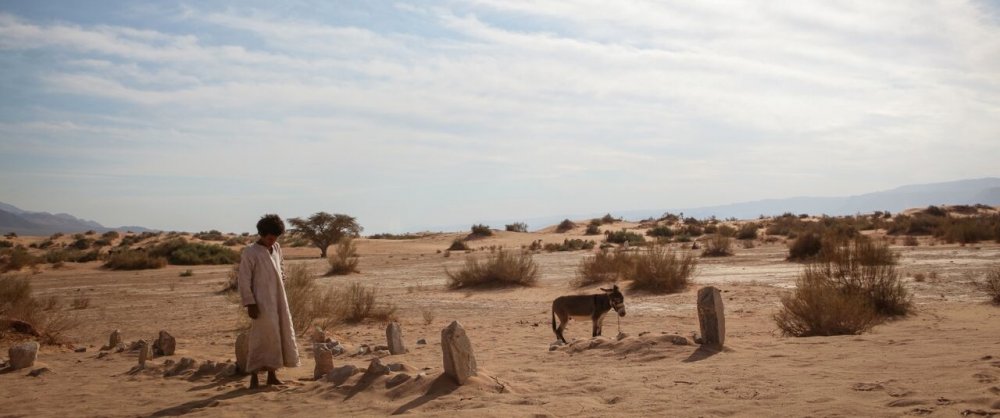
Last night we watched a film produced jointly in 2016 by the UK, Qatar, Jordan and the United Arab Emirates. The language was Arabic, the actors all but one, Arab and perhaps Turks, but it had French and English subtitles. Set during World War I, it took place in desert terrain, so the landscape was unfamiliar, forbidding and unforgiving. The star of the story was that of a Bedouin boy who with his teenage brother had inherited a tribal position from their father, recently dead, as a guide to pilgrims, and the older teen did just that for a British soldier and his Arab companion.

The goal was to lead them through the desert's strange and alien landscape with its low mountains and wadis, safely to an area where the Turkish military of the Ottoman Empire ran troop trains in its battle against Arab revolutionaries attempting to seize freedom from the Ottomans. Reminiscent of T.E.. Lawrence (aka Lawrence of Arabia) teaching Arab resistance fighters how to infiltrate Turkish lines and detonate bombs on rail tracks.
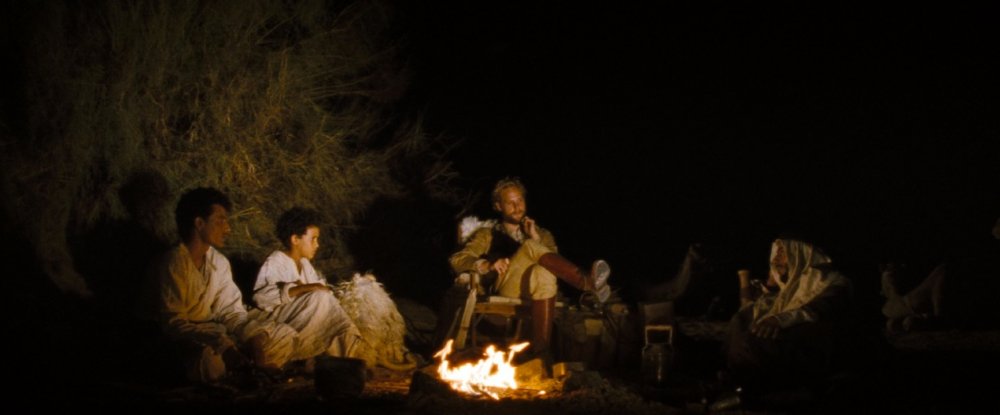
Theeb (2014)
The boy set out on a donkey to follow his brother Hussein, whom the desert had soon swallowed. By nightfall, on foot, stumbling through the desert after his donkey had refused hours earlier to go any further and he'd left it, he came upon the encampment of the two strangers, and his brother. After which it became a journey of three men and a boy.

It was tense, suspenseful and wracked with passion, intrigue and suspicion. The Bedouin Arab child winds up the only one alive after their group of four travellers are attacked by Arab raiders intent on securing the group's camels and anything of value they carried with them. The dangers of such attacks by brigands was understood to be one of the hazards of travelling through the area; the group escaped one such attack only to come under fire by another, all but the child losing their lives.

Although yet a child, likely no more than seven or eight years of age, the boy is preternaturally attuned to his environment and alert, carefully noting everything around him, both of the natural world and of the character of people. Unschooled in any sense of the word, but by his brother's efforts to teach him survival skills, even at his young age the harsh laws of the desert culture are alive and well in this child.
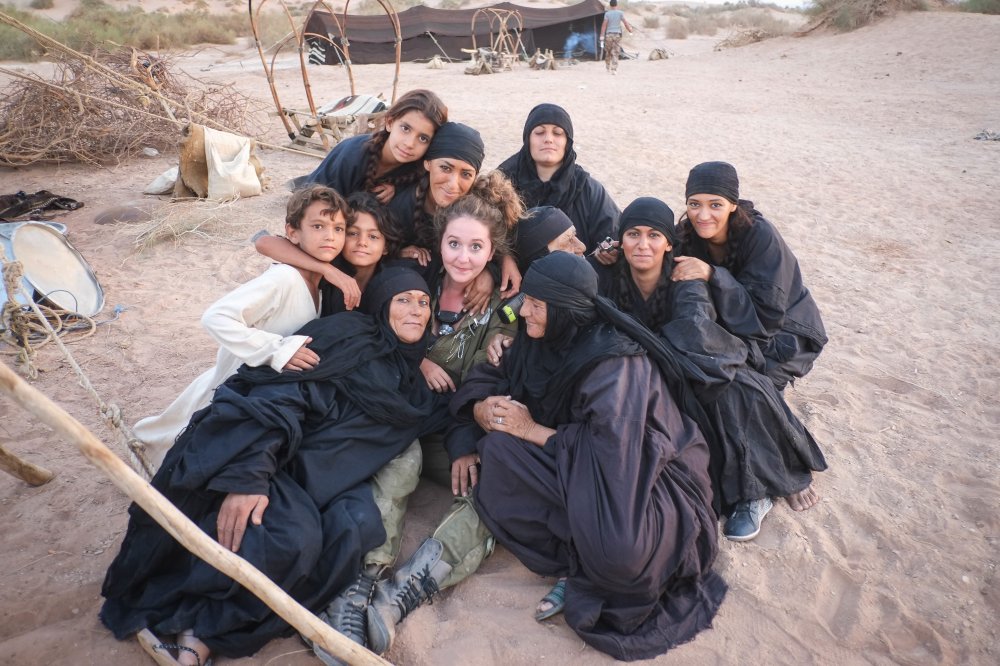
Behind the scenes with Bedouin women, their children and Theeb’s production designer Anna Lavelle
Credit: Laith Majali

As a contrast to the kind of life we live, it couldn't be more utterly alien. But living in a geography where resources to aid in survival are scarce, from water to food, building materials, to security from violence, it speaks of a sternly uncompromising heritage and culture of survival, where justice achieves its end from the barrel of a gun.

From the dun browns of the desert to the glowing greens of the landscape surrounding us everywhere we look, the abundance of food available, the comfortable homes helping us to deal with our environment, and the peace and security we enjoy and take for granted, it is living proof that two worlds exist.

We love our living landscape, the trees, the ravine with its many folds in the earth, the creek running through the forest, the birds flying about, the insects and the wildflowers. We have the security of knowing we are safe from violent harm imposed elsewhere upon those who are vulnerable to the predations of psychopaths, for we live in a land of law and order.

There, Theeb even at his tender age, knows that the strong dominate the weak. And he, like his brother and his father before them is determined not to be among the weak. He is a survivor.

Here, there is beauty wherever we look.

The film is titled Theeb, a film by Maji Abu Nowar.
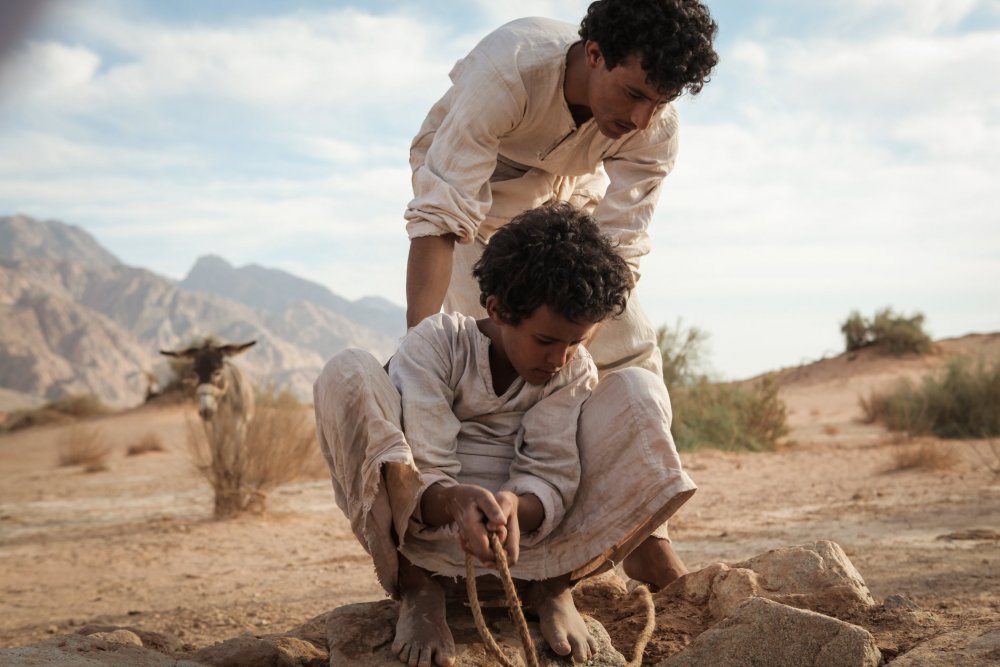
Theeb (2014)

Sunday, March 31, 2019


We had an intimation of what the day would allow us to do and what it would not be feasible for us to plan when we walked down the steps from our second floor to the first, glanced out the glassed front door and saw snow falling. We had no idea how long it had been snowing, but the fresh snow nicely covered the season's snowpack that had begun melting, freshening it beautifully.

We had to do the usual mental shrug of acceptance of the inevitable with March even if this was the penultimate day and March had been given ample opportunity earlier in its winter reign to wreak havoc on the landscape. Never satisfied, March always has more in store, and was unleashing that 'more' yesterday. When we were having our breakfast, looking out the patio doors we could see that the snow had intensified, falling in great fluffy gobs. Beautiful to behold, especially if it had been January, but the end of March?


No matter, down it came. But by noon it was over. Instead what had fallen as snow began coming down as freezing rain. Sleet is, for our purposes, less amenable than snow. No one in their right mind with two little dogs plans to head out to a forest for a leisurely hike along the ravined trails in pouring rain in a season that resents leaving in favour of spring's entrance.

The rain continued into the afternoon. Which meant no ravine walk. By that time I had decided that it was past time to begin what I had been putting off. Similarly, when looking out of the house onto a decidedly wintry landscape, our gardens deep in snow, the urge to begin spring cleaning just isn't there. Not that the prospect of indulging in days and days of cleaning out cupboards is anyone's idea of a particularly pleasant pastime...it's just one of those things you do. And so I began.


The pantry in the kitchen was my first target. It's a must-do, to take stock as an example, and get rid of things you can dispense with. I wrapped quite a few items in newspapers to take along to the Sally Ann recycling depot; glass vases, glass juice containers that I hadn't used in ages and likely never would again; small glass dispensers, extraneous baking dishes. And in that portion of the pantry where baking supplies, canned foods, jams, are kept some order was required and assessment of what was there and what might be outdated. It's a start.


From time to time one of us would initiate a bit of play through the day with Jackie and Jillie, to throw around tennis balls or knotted mittens that they much prefer to play with, to get them going until they felt like independently playing and tussling about with one another. Jillie is more of a snoozer, while her brother enjoys standing at the front door, barking and harassing the squirrels coming by for treats laid out on the porch.


In the evening, we watched three segments of a British Masterpiece Theatre series called Indian Summers; a fascinating drama focusing on the dying days of the British Raj. No other cinematic entities can beat British cinema at depicting itself as an arrogant, entitled occupier of a foreign land under the self-appointed task of relieving developing countries of their natural resources, in the process leaving them with the inestimable riches of British jurisprudence, bureaucracy, snobbery and cricket.

Theirs was in some ways an issue of noblesse oblige; viewing themselves as altruistically dedicated to the advancement of civilization to countries whose civilization long predated Britain's, endowing those countries with the indelible stamp of British colonialist rule. They viewed themselves as benevolent in their dictation to others what they should value and how they should behave.

Coincidentally, last night I finished reading 7 Years in Tibet, a fascinating first-hand account that described another Asian nation under colonial duress by a powerful neighbour whose outreach in the interests of territorial expansion was not resistible by a much smaller, less warlike nation of Buddhists. No one could ever accuse the Chinese of being guilty of benevolence toward others.

Sunday, March 11, 2018

Everyone needs a relief valve. Day to day throughout one's life there are episodes of disturbing events occurring which cannot be escaped, waiting to be dealt with. And we do the best we can to meet those challenges. Each one takes a toll on us. It isn't just the personal events impacting our lives, but the influence on our thoughts and consciences of what occurs to others.

World news certainly can have an emotion-dampening effect on anyone. People choose a course whereby they shut themselves off from news from elsewhere that is so disheartening. Ignorance, for them, is a kind of relief mechanism; what you don't know and deliberately remain oblivious to can't possibly trouble you. The reasoning that each of us struggles with our very own challenges in our lives and adding the problems faced by others that in their volume and depth dwarf our own provides no balm whatever, however.

There are those who seek comfort in drugs or alcohol, substances that can dim awareness and set aside woes and for the most obvious of reasons resorting to either only adds to the misery that these people are attempting to escape but manage to complicate. There are infinitely more benign methods of soothing one's emotions, close at hand and achieved through the benevolence of nature and of the arts.

Music soothes like no other medium of human construction, while the plastic arts come a close second. The champion, however, in allowing human nature surcease from the burden of simply being and enduring life's fortunes good or bad, is closeness to nature. We have removed ourselves from close proximity to nature in our modern era like no other time in human history. Any small urban plot of land that has been permitted to remain green represents an invitation to a tired soul to come and bask in its peaceful atmosphere.

Talented people are capable of producing novels that enrapture us with their explorations of the human condition, and they too have the potential of distracting, informing, entertaining and allowing us to set aside if only temporarily, our own deep-seated concerns. A broad step removed from the value that literature brings to us in reading is viewing films, many of which convey to us visually what literature does in invoking our imaginations.

For us, the opportunities to immerse ourselves daily in a wide urban swath of greenery within a forest where trails take us for miles on a quest for serenity, the ultimate restfulness and renewal of spirit is possible. How did our Sunday reveal itself? Most pleasantly. With our two little companion dogs we ambled at a comfortable pace through a ravined forest we're fortunate enough to live beside. The pristine beauty of a forest in the direct wake of a winter snowfall has few peers. And so, this enabled us to enjoy ourselves to the fullest; taking due note of the landscape itself and watching as two little creatures disported themselves in an excess of energetic joyfulness through their own exposure to nature's arras.

In the evening, we viewed a superior film presented by the Cohen Media Group, a film from the heart of a Turkish director, Deniz Gamze Erguven, of the lives of five siblings, young girls raised by a doting grandmother, maturing to womanhood and the rude interruption and distortion of their existence as they become cultural/religious commodities. Mustang is a film whose value cannot be overstated.


Sunday, February 4, 2018

Based on the forecasted several degrees of elevation i temperature, and absence of the cutting winds of the day before, we made the somewhat rash decision not to dress as snugly as we had previously, setting our for our daily ravine walk in fewer layers against the cold yesterday. That turned out not to have been a wise choice. True, the cold didn't have quite the icy depth as the day earlier, and nor was the wind as grating against our faces, but it didn't seem that way.

We felt extremely cold out on our daily ravine walk yesterday, quite surprising us, as experienced as we are. We hadn't put boots on Jackie and Jillie reasoning that the cold was just on the cusp of what they're comfortable with. They didn't appear to be having any difficulty romping about in the freshly-laid, fairly light new layer of snow, to our relief however.

Later, in the evening, we put together our Saturday night pizza, after spending close to an hour dancing lazily over the kitchen floor to music Radio Canada entertains us with regularly, dating to the era when we were young. After our pizza dinner, enlivened slightly with the addition of anchovies torn over the chopped mushrooms, bell pepper, tomato and cheeses covering the bread dough I'd prepared on Friday then refrigerated, we gathered ourselves, we and our two little dogs, to view a film.

This film, Dersu Uzala, took place in Siberia at the turn of the last century, a collaborative work between Russia and Japan, the screenplay written and the film directed by the incomparable Akira Kurosawa, whose films are the very essence of cerebrally haunting views of humanity.

This one was no exception, a quiet, body-language-expressive, deeply moving account of a small military mission dispatched in a mission to survey the mountainous and flat-vista areas representing the border between Russia and Mongolia. The hostile and starkly beautiful environment, the endless physical challenges encountered and the collegial link between the small military group and an elderly Mongolian hunter who serendipitously became their guide became the focus of the film, gripping in its portrayal of determined humankind versus raw nature.

We went up to bed a little later than usual for a Saturday night, feeling pensive about what we'd seen and appreciative of the talents of everyone involved with the film, filmed in the late 1970s. Kurosawa's directorial oeuvre is second to none other; the world lost a filmic genius on his death.

Image result for dersu uzalaImage result for dersu uzala