Monday, May 24, 2021

Just a Few Questions We'd Like Answered, Beijing...?

This aerial view shows the P4 laboratory on the campus of the Wuhan Institute of Virology in Wuhan in China's central Hubei province on May 27, 2020.

Even though the World Health Organization sent an investigative team to Wuhan, China, to look into allegations that the SARS-CoV-2 virus that causes COVID-19 might have been initiated as the result of a viral 'escape' from research being carried on at one of two laboratories in the city, the investigative team reached no conclusion. Their intention was to interview the Chinese scientists at the laboratory, and to visit both the high-security (P4) laboratory and the wild food market that the laboratory insisted was the source of the outbreak.

The WHO team was never permitted any independence, always accompanied by both Chinese authorities and members of the high-security laboratory. Their findings were 'guided' by Chinese authorities who strenuously denied any possibility that the virus could have escaped from the laboratory confines. This, though it was known and reported by visiting scientists that conditions at the laboratory were not as strictly controlled as they should be for such a high-security laboratory working with deadly bacterium and coronaviruses.

Beijing has been criticized from day one for its lapse in immediately notifying the WHO that a new virus was wreaking havoc on Wuhan. Initial reports played down the serious nature of a strange new type of pneumonia arising in Wuhan hospitals that was not responding to usual treatment, and causing deaths. Soon enough the world became aware of a young eye doctor who alerted his colleagues through social media of a peculiar and dangerous new virus, and who was brought before authorities for 'spreading false news'. He contracted COVID himself and died of it.

Now The Wall Street Journal has revealed that three employees of the Wuhan Institute of Virology had been taken to hospital as a result of symptoms now familiarly associated with serious bouts of COVID-19, a full month before the authorities in Beijing alerted the world of the presence of a new and extremely disturbing virus that had somehow leaped the species barrier from animals to humans. Beijing is well known to have kept possession of critical, sensitive information  the investigators were interested in studying.

What swiftly took place since December of 2019 across the globe as SARS-CoV-2 swept through the world is well enough known; a coronavirus pandemic we're still struggling with over a year-and-a-half on. But with the misfortune of the global pandemic came a ray of light, as soon afterward highly effective vaccines emerged out of other laboratories to throw a lifeline to humanity. 


Once China had got its outbreaks under control after screaming 'racism!' when it was offended that closed-border recommendations took effect, it focused on producing a number of vaccines. While denying it was responsible for the global outbreak of a dangerous new zoonotic, Beijing saw an opportunity to ingratiate itself to the world, as the manufacturer of anti-COVID vaccines which it would generously share with an ailing world. 

Although China was the first country out of the starting  gate with its vaccines, it has never produced a vaccine with a high efficacy rate. Its four different vaccines which it has trialed in a number of countries facing desperately high COVID-19 rates, like Brazil,  have been anything but successful, with an average efficacy rate hovering around 50 percent, as compared to the leading Western vaccines with rates of 85 to 95 percent efficacy.

The world deserves answers to some of its questions. China's reaction to a situation which impacted the entire world was first and foremost to protect its reputation. Any responsible government must recognize that in a situation of this magnitude that would swiftly affect the global community, it would have an obligation to act swiftly and decisively. Beijing chose not to. The long-suffering people of China deserve better from its suffocating government.
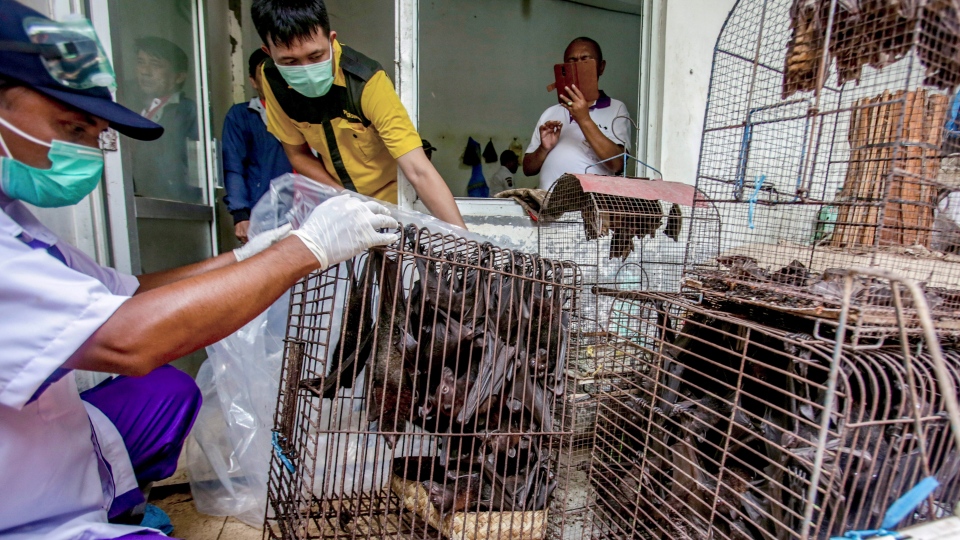
Indonesia live markets
In this March 14, 2020 file photo, health officials inspect bats to be confiscated and culled in the wake of coronavirus outbreak at a live animal market in Solo, Central Java, Indonesia. The WHO on Tuesday urged countries to suspend the sale of live animals captured from the wild in food markets as an emergency measure, saying wild animals are a leading source of emerging infectious diseases like the coronavirus. (AP Photo, File)

Sunday, May 23, 2021

So yesterday afternoon was spent planting the remainder of the seasonal plants in the backyard garden and the garden pots. Finding a home for the irresistible new hosta, the begonias, the wave petunias, the dracaena, the impatiens and the two lovely new Hibiscus shrubs. Not the best of times to move immature flowering plants around, on very hot sunny days, but it was by then late afternoon and some shade had moved in. 

Taking stock in the garden, the irises have set their blooms and they'll open in days. Mountain bluet is now in full bloom in both the front and back gardens. As are the Columbine plants. They tend to plant themselves, mysteriously, as many plants do, but discreetly, a new plant here, another there, they're not garden thugs wanting to take over other plants' assigned territory, and we're always glad to see them.

The forget-me-nots are shining their pretty little blue faces everywhere; they have a tendency to look after themselves year after year. Already there are tiny new seedlings of Morning Glories, renascent beyond order at the top of the rock garden, so I have to pluck the excess seedlings to maintain some vestige of proportionality, else they overgrow everything else.

The Mountain Bluet both at the back of the house and in the gardens at the front of the house are in bloom. As is the two flowering peas. The Icelandic poppies are sending up their flowerheads, soon to open. Our garden Jack-in-the-Pulpit plants have attained gigantic proportions and they're spreading among the ground-cover foamflower and spurge.


 This has turned out a cool, windy day if you're in the shade. Once again I took time to sweep up the piles of wind-strewn petals from the Jade and Sargentii crabapple trees, along with those of the large Magnolia. The minute the piles are swept up, the wind sweeps down a new batch to replace the old. The smaller magnolia tree in the backyard bloomed later, so it still has some of its gorgeous huge pink blooms intact.

After Irving finished cutting the grass, we invited Jackie and Jillie for a swing through the woodland trails in the ravine and they thought it to be a fairly acceptable idea. The atmosphere couldn't be more perfect; cool and breezy, mosquitoes and black flies at bay thanks to the wind. Irving picked up a walking stick he had leaned against a tree yesterday at the time of the access trail to the ravine's forest.

We often come across a pair of very nice young women walking their two dogs, a Golden Retriever and an Apricot Poodle mix, the two affable dogs took an instant fancy to the stick Irving was carrying, so taking heed of their commandeering suggestions, Irving surrendered the stick to them, and they happily carried it off a short while. Engaging in a bit of competition over the stick, they finally left it as they carried on with their humans, so Irving retrieved it for use during the remainder of our hike.


When we returned back home, we all settled down in the garden for a short while, to look around, enjoy the immature garden aspiring to summer munificence, and took our rest in the shade offered by the trees that surround the front of the house; spruces, magnolia, crabapples, false cypress, all providing shade, as their crowns take the brunt of the heat and brightness of the sun.


Saturday, May 22, 2021

We slipped out briefly late yesterday afternoon to drop by an area plant nursery to pick up a few pot fillers. Irving waited in the truck with Jackie and Jillie, and I wandered the rows of offerings, unimpeded by the presence of many other garden plant seekers and it was just as well since between rows there wasn't much room to negotiate space. 

So much of the vegetation was in pretty iffy condition, badly in need of watering. That doesn't do much to inspire confidence in the product. They did have some irresistible plants, though, some that I hadn't already been able to access, so I stayed and looked around and ended up with a few additional items like wave petunias and New Guinea impatiens, a mature hosta whose colour variations I couldn't resist, and a couple of immature and lovely hibiscus shrubs that had set buds, a few of which were in delightful bloom.

And today would be the day I would complete the planting of the garden pots. Just to tuck in a few fillers in the already-planted urns and pots in the front garden, but my attention would be to the back garden whose pots had just been filled with fresh soil yesterday. 

First things first, though. We were into yet another hot, steamy day, so first thing after getting up Irving suggested we might consider having our ravine hike before breakfast and since we all thought that was a really good idea, that's just what we did. Evidently Lyme Disease diagnoses is increasing in this area, year over year. It's the time of year when black-legged ticks (deer ticks) are about, easy to pick up.

We hadn't given it much thought, actually, since we always dress sensibly, seeing that our arms and legs are lightly covered for optimum protection from all pests, and Jackie and Jillie are given medication against ticks through the summer months. People we pass on the trails invariably wear tennis shoes and socks and shorts, with bare legs, bare arms. Even long-time hikers leave themselves exposed. The symptoms of Lyme Disease are pretty awful, but everyone's mind lingers on COVID-19.

At that time of the morning, between 8 and 9, it tends to be on the cool side, the heat of the day hasn't yet had a chance to gain momentum, and with a light breeze it's extremely comfortable. The bright green of the new forest foliage confers an aura of coolness, as it shelters us from the searing sun. We took our time, enjoying the atmosphere and the landscape as we always do. Stopping on occasion to chat with someone we hadn't seen in ages.

And pleased to come across honeysuckle in the forest understory, already in bloom. And in another area of the forest, spring phlox in bloom. Our garden phlox won't be ready to bloom until mid-to-late summer. We're really awestruck over the efficiency of nature. From early spring when everything looks so barren, desiccated and grey, to the present where green has returned in lush plenty, the transformation seems so remarkably swift.


And it's no different in the garden. It looked so incredibly dismal, bare and miserable two months ago when the ground was finally defrosting and tentative little green shoots began popping out of the garden. Now, our 30-year-old tree peony is in full bloom, surprising us as it does every year. 


Friday, May 21, 2021

We really are getting fairly parched here, we could use some rain, actually lots of it. We keep getting weather forecasts from Environment Canada assuring us that there's a significant percentage-potential for rain, for showers, for thunderstorms, and none appear. We would welcome any of them enthusiastically, and all outdoor vegetation even more so.

Another hot day, although not as muggy as yesterday, just hot with the sun streaming relentlessly through clear skies, relieved by a generous cooling wind that even followed us this afternoon into the forest. Early enough in the day so it was not yet suffocatingly hot, we did a little weeding, watering and tying up clematis vines in the garden. And Irving set about filling garden pots in the backyard with fresh garden soil, sheep manure and peat moss, so I can proceed with the planting.

He assessed the quantity of plants I have in stock (and I reminded him I've got some seed packets; nasturtiums grow quite quickly from seed) and declared them to be insufficient to the task. Mostly because he filled up more pots than I recommended be done, because he was on a roll, and had to 'empty' the wheelbarrow. So we put that aside and instead headed out to the ravine before the heat of mid-afternoon moved in, taking care to remember a water bottle for Jackie and Jillie.

They had come calling for us to get under way. They were fairly enthusiastic about accompanying us outside to the garden, but lost that good feeling about being out fairly quickly, given the micro-climate of the backyard permanently set to boil, whereas the front is merely on simmer and we spent more time in the back that the front gardens.

Finally, we prepared to be off, the air oppressive but dry, the sun baking our backs, and wind cooling our faces. Unlike yesterday when the wind decided it had no business in the forest interior, it changed its mind today and kept us company. Despite which, though some relief was to be had, it was hot. Even so, there are areas throughout the trails where we suddenly step into a cooler atmosphere and other places where it's hotter; elevation of course plays a role there.

For a change we stopped quite a few times to offer water to Jackie and Jillie, and while on some days they aren't all that interested, this afternoon each stop had them guzzling down cool water. Other people are more practical about the situation, allowing their dogs to stream directly for the cooling water of the ravine's creek. Even if we allowed our two to head for the water they'd refuse; for poodles they're fairly averse to getting wet.

The six dogs our friend the dogwalker looks after have no such thoughts of avoidance, they all head straight for the creek, it's obviously a highlight of their daily romp through the woods. They emerge sleek and dripping, shaking off the excess  so you'd be foolish to stand nearby. Clearly refreshed, however, the heat of their paws momentarily lifted. The water isn't very deep and a large dog can stand
half submerged, no more in most places, but happily relieved of the burden of enervating heat, however temporarily.

We've seen the Serviceberry trees in bloom now, but at a distance and not fully revealed. They tend to be smaller trees growing amidst the larger deciduous trees of the forest. It's likely they grow much more robust in Western Canada, where they're called Saskatoon berries, and used liberally for baking pies. In some parts of the forest a divine fragrance delights us; a combination of wild apple, hawthorn, cherry and serviceberry all in bloom. And dogwood too, of course beginning to come into bloom, and soon the honeysuckle will also be blooming.

Speaking of dogwood, there was a time when we saw quite a few little patches on the forest floor of ground dogwood, perhaps more familiarly known elsewhere as bunchberry. Those patches haven't been seen in years. But we did come across several specimens last year on the main trail that goes along the ridge of the ravine and as it happens, today Irving spotted one lonely little bunchberry in bloom, its pretty little white head all alone, surrounded by vegetation of the forest floor thriving where the bunchberry have vacated tenancy.


Thursday, May 20, 2021

I haven't yet succeeded in persuading Irving that the local wildlife is no longer (if they ever were) in need of handouts, they're perfectly capable of foraging for themselves; it's what nature has taught them to do in fulfillment of her imperative given all her creatures; survival. Strange as it seems, he feels 'responsible', now that he has once again accustomed our little visitors to coming around for treats, to ensure that they're well fed. And they are.

From squirrels to cardinals, the occasional rabbit or skunk to crows and sparrows, chickadees and nuthatches -- and of course, our very special raccoon, assuming there's only one. Each time we do the grocery shopping, my husband tosses in crackers not meant for us, and huge cereal boxes not meant for us, which end up being scattered on the porch floor, along with any toast or pancakes or French toast left over from breakfast.

Although the little raccoon comes over at any time of day -- afternoons in broad daylight -- seeming to suit him just fine sauntering over from the ravine, last evening just as darkness smothered the landscape, there he was, patiently waiting under the wrought-iron porch loveseat. He remained there while Irving hurriedly refreshed the depleted offerings, upon which the little fellow immediately emerged and began comfortably helping himself, most of his competitors sound asleep for the night. 

Yesterday I accidentally gave myself a 'fat lip'. I discovered years ago that the dry-dusting floor mops that I favour are no longer available. Oh, there are some, but instead of wool, the fabric is oil-based and doesn't pick up dust. My online searches found a product that looked perfect, but they wouldn't ship from the U.S. to Canada, given the awkwardness of shipping something with a long wooden pole attached to a mop-head.

I kept looking and found an industrial cleaning supplier in the city who when I called said they were open to the public, not only the trade. And along we went, and there I picked up an industrial size-and-strength dry mop and several heads. And while I was there, an assortment of lambswool dusting wands which still serve me well. The mop's stick was so long I couldn't handle it, so Irving sawed a foot off it. I became accustomed to its weight and have been using it for at least five or six years. Holding the till-long mop handle at an awkward angle yesterday when I was dusting the dining room floor I managed to thrust the top against my mouth and boy, it smarted!

After using the thing for so many years, every day of the week, a bloody lip. I'm meticulous about ensuring that no scintilla of food remain anywhere on the kitchen or dining room floors because when we lived in Atlanta and Tokyo, rats and cockroaches could be guaranteed to visit at such places where discarded food might be available. The moderate-to-hot, moist weather is perfect for them. And though there's far less likelihood of such visitors here, the habit is now well entrenched.

As is, for us, taking our two puppies out daily for long saunters through our nearby ravined forest. For us the exercise, and the pleasure of a natural woodland scene unfolding before us as we amble along the forest trails, for them, much the same. And we're never disappointed in the changing scene we come across, season to season. One more day of spring; where has the season gone, for heaven's sake!

Trilliums are now in short supply; the foliage remains but the flowers, bright crimson, have mostly faded but for the occasional later-blooming trillium, still retaining intact flowers, albeit few and far between, now. The other late-spring standbys, trout lilies, are there in foliage form, their flowers long since dissipated (not long, about a week or so). 

This year we've noted there are now more Jack-in-the-Pulpits than ever before. Decades ago there was just one part of the raven where a few Jacks could be seen, now they're almost everywhere. Not in great abundance, but with a noticeable presence -- if you know what to look for, where to look for them, and recognize them for what they are. We can both still recall as children in elementary school 70 years ago, learning about Ontario wildflowers; doubt if that still prevails.

Then we saw that the dogwood shrubs too are now beginning to bloom, joining the hawthorns and the black cherry trees and the wild apple trees that had begun a week earlier. Oh, and the False Solomon's Seal too is setting its floral spray, just as has red baneberry, in greater display this year than last, when hardly any could be seen on the forest floor. A virtual cornucopia of wilddflowering everywhere we looked.

What is absolutely bedazzling though, is the speed with which the greening of the deciduous trees takes place. the forest canopy is a now a bright green blaze, and apart from the beauty of a fully-leafed forest there is the practicality (for us) of the canopy providing shelter for trail-hikers during times of light rain. Which we experienced today, a hot, humid day, sun sun, some rainclouds, but no big rain event yet.


Wednesday, May 19, 2021


Today, at 27C, light wind and full, searing sun won't be the hottest day this week. Irving finally shut off the furnace and adjusted the air conditioner to come on if needed. And brought a few fans up from the basement. He was out, first thing after breakfast this morning, to water the garden urns, pots and beds. Everything is getting parched. And exposure of any duration directly to the sun is enervating. For humans and other animals and the vegetation we're surrounded by.

We were out actually, earlier in the day, to do our grocery shopping. Wednesday isn't normally a shopping day, but yesterday morning, which was, passed by without our getting to the supermarket. The night before I'd awoken suddenly feeling nauseated and hit with a bout of diarrhoea, feeling like death warmed over, after retching. The next morning, fine, but tired, so no shopping expedition. Instead, we slept in a lot longer than usual, then we took a fairly long hike through the ravine in the afternoon.

There are strange things happening under the midnight sun and all I wanted was a good night's sleep, not looking for a pot of gold. We've both been hit by some kind of bug, but we're recovering. We're getting our appetites back, and feeling a whole lot better. And then we took Jackie and Jillie out this afternoon for their usual round through the forest trails. We walk them up the street the short distance it takes to reach the ingress point to the ravine and the forest below, then remove their leashes and they're free to poke about.


Any time they sense other dogs are around they're alerted long before we see or hear their approach. This time it was, for them, the familiar smell/sight/sound of a group of five, sometimes six dogs that are regularly taken through the ravine by a dog walker we've come to know the past several years. They're all kinds of dogs, from a tiny dachshund to a small collie and several Labs. All of them had been in the creek and were happily dripping, relieved momentarily of the heat, feeling well refreshed.


Poodles are also supposed to be water dogs and our little miniature poodle Button was an enthusiastic water dog, but we never allowed her to indulge in the creek, because once when she was young, her dew claw had been severed by a broken bottle that some brilliant teen had tossed into the creek. We no longer see discarded bottles or cans, but our two don't go into the creek because they have no wish to.

Eyes peeled for sight of Jack-in-the-Pulpits, we weren't disappointed. The earlier-to-appear ones are now fully formed, and later specimens are just now beginning to erupt. The trilliums have had their glory days and are now fast fading. But the lilies-of-the-Valley crowding the base of tree trunks have proliferated and many are now in bloom.

Although we had more than adequate shade-shelter from the searing rays of the sun, the signal is there that henceforth on such warm days a necessary part of our gear apart from harnesses and leashes is a water bottle. Sometimes Jackie and Jillie are thirsty, more often they're not, but it's best to have one on hand on these energy-depleting days when they dash about despite the heat, then have their tongues hanging out.

We were surprised to come across a little clump of flowers far more familiar to us in our spring garden than on the forest floor. As sometimes happens, seed, either carried by the wind, or within the food-waste of a bird falls, takes root, and the forest welcomes and nurtures a visitor. Sometimes those visitors take up permanent residence, but more often they don't last past a season. For several seasons we've seen tomato plants on a part of one of the trails struggling to produce fruit.

For forest denizens like the black cherry trees whose habitat this forest is, it's time to flower, and they're doing so generously. The forest understory also plays host to many kinds of dogwood shrubs and they too are beginning to form their flower heads. A hike through the forest in any season is never a bore, there is always something to see or hear that is unusual, drawing attention and speculation. 


Tuesday, May 18, 2021


It is nothing short of astonishing, the rapidity with which nature urges her vegetation to mature once they have freed themselves from the confines of spring-thawed soil. Perennials are celebrating their freedom to flaunt their presence, filling up the garden beds and borders with form, texture and colour. On the one hand we're delighted when we see how swiftly flowering fruit trees bear their blossoms, and sad because it seems so quick that the wind disturbs the perfection of blossom clusters, breaking up their comradely togetherness, and scattering petals everywhere, carried by the same breezes that shattered their perfection.

A growing pile of confetti, pink and fragrant, now litters the ground and the walkways under the Sarjentii crabs, and the flowering Jade crab on the opposite side of the garden though it flowered later than the others, won't be long in joining them casting their petals to the wind, as the white perfection of exquisite flowers packed on every branch begin their disintegration.


On the other hand, in the beds and borders, hostas are stretching their newly-awakened limbs, so to speak, unfurling their graceful foliage, along with the hydrangeas and the lilies and the irises, the spirea, the alliums and the tree peonies. The planters we've placed here and there along the garden wall when Irving dug deep into the soil to excavate building detritus and replace it with gravel, sand and fertile soil then built the stone retaining walls and laid down the brick walkways twenty-five years ago, are themselves blooming with new life in the colourful annuals we were able to collect from an area horticultural family.

The garden gave us an enthusiastic send-off this afternoon, as we left the house with Jackie and Jillie to make our way to the forested ravine beyond the street we live on. It's been such a superlative weather day, with a high of 25C, freshening breezes and mostly intensely full sun, we couldn't resist deciding to take a longer-than-usual toddle through the woodland trails.

We hadn't seen the pair of Mallards steaming along the creek in the past several weeks, but other trail hikers assured us they were there, mostly comfortably ensconced in the area of the beaver pond, where they would be undisturbed by the presence of continual passers-by. When we saw them this afternoon, once at the start of our hike, and another time when we had doubled back on our circuit,they were serenely unperturbed at our presence, calmly going about their business, the drake's electric-green head and neck brightly shimmering in the sun.