Showing posts with label Research. Show all posts

Monday, May 24, 2021

Just a Few Questions We'd Like Answered, Beijing...?

This aerial view shows the P4 laboratory on the campus of the Wuhan Institute of Virology in Wuhan in China's central Hubei province on May 27, 2020.

Even though the World Health Organization sent an investigative team to Wuhan, China, to look into allegations that the SARS-CoV-2 virus that causes COVID-19 might have been initiated as the result of a viral 'escape' from research being carried on at one of two laboratories in the city, the investigative team reached no conclusion. Their intention was to interview the Chinese scientists at the laboratory, and to visit both the high-security (P4) laboratory and the wild food market that the laboratory insisted was the source of the outbreak.

The WHO team was never permitted any independence, always accompanied by both Chinese authorities and members of the high-security laboratory. Their findings were 'guided' by Chinese authorities who strenuously denied any possibility that the virus could have escaped from the laboratory confines. This, though it was known and reported by visiting scientists that conditions at the laboratory were not as strictly controlled as they should be for such a high-security laboratory working with deadly bacterium and coronaviruses.

Beijing has been criticized from day one for its lapse in immediately notifying the WHO that a new virus was wreaking havoc on Wuhan. Initial reports played down the serious nature of a strange new type of pneumonia arising in Wuhan hospitals that was not responding to usual treatment, and causing deaths. Soon enough the world became aware of a young eye doctor who alerted his colleagues through social media of a peculiar and dangerous new virus, and who was brought before authorities for 'spreading false news'. He contracted COVID himself and died of it.

Now The Wall Street Journal has revealed that three employees of the Wuhan Institute of Virology had been taken to hospital as a result of symptoms now familiarly associated with serious bouts of COVID-19, a full month before the authorities in Beijing alerted the world of the presence of a new and extremely disturbing virus that had somehow leaped the species barrier from animals to humans. Beijing is well known to have kept possession of critical, sensitive information  the investigators were interested in studying.

What swiftly took place since December of 2019 across the globe as SARS-CoV-2 swept through the world is well enough known; a coronavirus pandemic we're still struggling with over a year-and-a-half on. But with the misfortune of the global pandemic came a ray of light, as soon afterward highly effective vaccines emerged out of other laboratories to throw a lifeline to humanity. 


Once China had got its outbreaks under control after screaming 'racism!' when it was offended that closed-border recommendations took effect, it focused on producing a number of vaccines. While denying it was responsible for the global outbreak of a dangerous new zoonotic, Beijing saw an opportunity to ingratiate itself to the world, as the manufacturer of anti-COVID vaccines which it would generously share with an ailing world. 

Although China was the first country out of the starting  gate with its vaccines, it has never produced a vaccine with a high efficacy rate. Its four different vaccines which it has trialed in a number of countries facing desperately high COVID-19 rates, like Brazil,  have been anything but successful, with an average efficacy rate hovering around 50 percent, as compared to the leading Western vaccines with rates of 85 to 95 percent efficacy.

The world deserves answers to some of its questions. China's reaction to a situation which impacted the entire world was first and foremost to protect its reputation. Any responsible government must recognize that in a situation of this magnitude that would swiftly affect the global community, it would have an obligation to act swiftly and decisively. Beijing chose not to. The long-suffering people of China deserve better from its suffocating government.
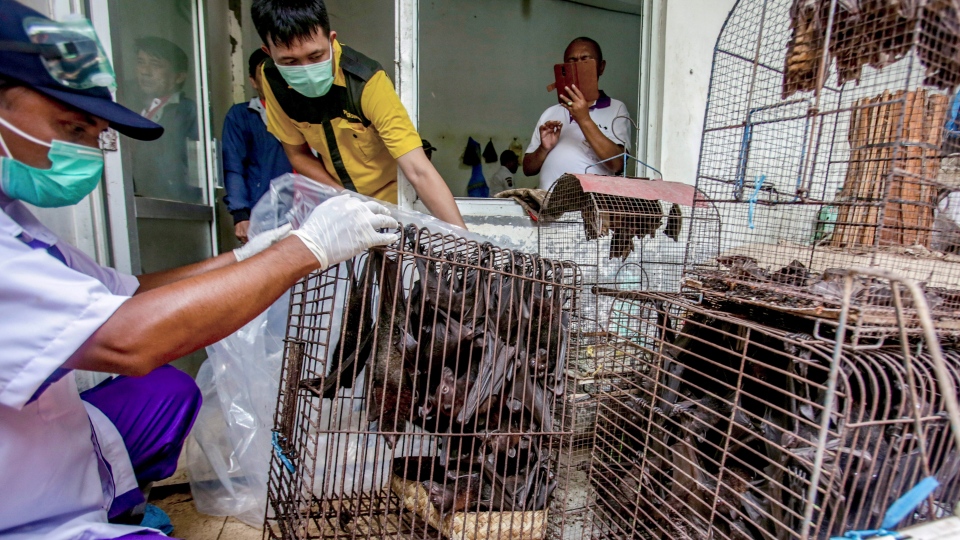
Indonesia live markets
In this March 14, 2020 file photo, health officials inspect bats to be confiscated and culled in the wake of coronavirus outbreak at a live animal market in Solo, Central Java, Indonesia. The WHO on Tuesday urged countries to suspend the sale of live animals captured from the wild in food markets as an emergency measure, saying wild animals are a leading source of emerging infectious diseases like the coronavirus. (AP Photo, File)

Monday, July 27, 2020

Whistler BioBlitz 2020 : Biologists Having A Blast!

The Fire of Life: metabolism and energy flow in animals and ecosystems by ecologist Jordan Rosenfeld

Jordan is an aquatic ecologist who lives in Vancouver. His childhood was spent in Ontario collecting bugs and falling into streams. He eventually blundered out to the west coast, where he studies the effect of habitat on ecological processes in streams and energetic constraints on fish distribution and abundance. His specific research is focused on modelling fish habitat, habitat requirements of fish species at risk, optimal stream flows, bioenergetic modelling of juvenile salmonid growth, and understanding how habitat structure affects energy flow in streams. In his spare time Jordan likes to sit on a couch watching TV.

BlitzPembi-JR-180609-087

"Metabolism has been called the fire of life because low-temperature oxidation of organic matter is what powers animal (and plant) life on planet earth.  Although metabolic differentiation isn't obvious like wing shape or colour on birds and butterflies, it underlies much of global diversity.  I will consider variation in metabolism from animals to plants to ecosystems, and present a bunch of random factoids that I Googled on the internet at the last minute or just made up."

BioBlitz-JR190608-003.jpg

In July, we are planning on hosting scientists for the field portion of BioBlitz. What makes BioBlitz so exciting is that every year BioBlitz scientists find on average 200 species that we didn’t know existed here. The Whistler Biodiversity Project already has a list of over 4,300 species so to keep finding new ones is amazing. There is so much to discover right in our own backyard!

Tuesday, July 7, 2020


Quite some summer this is turning out to be. Peoples' vacation plans disrupted, but what's far worse for many people, disruption is not merely the setting aside of holiday plans, but the complete upending of social/cultural life as we've long been accustomed to. Last January when we first read brief inconsequential news stories carried by the international press as casual items about a newly discovered virus in China, we would never have thought ahead to a time when our lives would be influenced in such a manner by that very same virus travelling with lightning speed as it infects millions of people globally.


Now, six months later we're living a strange reality of caution and concern, where spontaneity spells the possibility of unwanted contact and infection, mandating that we think carefully in a manner that contradicts human nature. The wearing of protective face masks is becoming universally mandated. Scientists are working overtime in a frantic effort to discover what has never before been created, a vaccine against a rampaging virus.


The other unusual, but relatively innocuous difference this summer is the ongoing, relentless heat where one day follows another heading to a high of 30C and beyond, a stifling oven of light-and-heat emitted by the sun impacting on our lives in a coincidental display of nature having sent us a life-threatening zoonotic and on the sidelines physical discomfort and a threat to the environment in drought and wildfires.


The temperature here has risen perilously close to the mid-30s and it will continue to do so throughout the rest of the week, following on a similar situation the week before. When we awaken after a heated night to a brightly re-heating day, we gather ourselves first off to take advantage of a cool, shaded landscape that the forest provides. As we did this morning. As we've done for much of mid-to-late spring and now summer. Deep shade can be guaranteed in the forest, enabling us to enjoy the landscape of green living vegetation, exercise our limbs, and breathe in air scrubbed of urban impurities.


With the recent proliferation of Elderberry trees alongside the creek at the bottom of the ravine, their bloom has added a sweet fragrance to the refreshing air as we navigate a trail that takes us past their serried order. Mosquitoes seem less invasive somehow in the earlier morning hours. And it's cool enough at that time of day that we can enter the forest trails with limbs covered against mosquito stings because we don't use insecticide and prefer to cover up instead, something we couldn't do in the heat buildup of the afternoon.


While we were out today, someone noticing my camera (which rarely leaves my hand for my pocket) stopped to talk about photography and the urge to take pictures of everything we see; as apt a description of me, as any. Just a few minutes earlier when we'd stopped briefly to have a conversation with a young woman walking her husky and her infant daughter, she had also mentioned my camera, inquisitively. Likely because I'm never seen there without it, though it never passes my mind that anyone might be curious, much less notice. And just as though we were on vacation when people sometimes spontaneously offer to take your camera and turn it on you -- which has happened to us before -- the man did just that.


Yesterday, when we exited the ravine my husband stopped at the group mailbox. We don't often check in on it; very little mail is sent and received these days. But within our little box was a kit sent out by a research group conducting a national study on the novel coronavirus and its impact on the Canadian population. Weeks earlier I had completed a national survey online for a polling/research group. At the conclusion of the poll there was information about the study with a request that anyone willing to take part in the survey indicate so. And so I did.


That kit was a response to my having agreed that I would lend myself to the study being carried out through the auspices of the University Health Network out of Toronto, linked with the University of Toronto and other allied groups. Called the Action to Beat Coronavirus (Ab-C) in Canada, it sets out to determine how many in the country have been exposed to COVID-19, through analyzing blood samples for traces of antibodies or other metrics.


The kit contained an explanation of the project, alcohol wipes, sterile gauze, bandages, lancets, and a return envelope, along with a blood-collection 'card' to receive blood samples. And a consent form, to be included in the study. The completed samples to be returned to the source, through a provided self-addressed, postage-paid envelope, with the intention of launching the research using an anticipated 10,000 to 14,000 returned and completed blood tests.