Winter politely knocked at our door yesterday. When we awoke in the morning it was to be greeted with a thin layer of snow. Always a surprise, that first snowfall, light as it normally is. Repeat performances introducing the early stages of winter onset year after year never quite prepare us for the reality. Along with the snow there was a cold, biting wind, matching the colder-than-normal atmosphere. Not that it is particularly early in the season for our first introduction; in other years we've experienced heavy snowfalls around this time.
Because it was so bitter out, we waited until early afternoon before setting out for our daily ravine jaunt. By then the light snow covering had melted. And for the first time this season we dressed in warm layers against the chill wind. Out came winter jackets for Jack and Jill, and their harnesses went neatly over the jackets. On came our own winter jackets, gloves and hats.
We don't really appreciate November days; they're invariably dark and brooding, a gloomy atmosphere and appearance seems to settle over everything, little colour is seen and we miss the sun. Yet, perhaps because I was forced to miss almost an entire week of ravine jaunts last week as a result of my sprained foot, everything looked wonderful, even the fallen foliage, now turning from a monochromatic yellow to that ghastly brown-grey of crumbling leafs as colour drains from them. The woods look empty, in a sense, the trunks of trees appearing like dark masts against a moderately darkened arras, the sky above metallic grey, with darker clouds hovering into view.
Even so, now I find an austere beauty in it all, and stop from time to time to gaze more deeply at the layers of detritus mounded on the forest floor descending gracefully into valleys, the denuded trees marching off into the distance in their various sizes, the deciduous interspersed with the presence of dark green pine needles; spruce, fir, hemlock, cedar and yew.
Jack and Jill didn't seem to mind their snug coats and trotted along with their usual sense of purpose and curiosity to be satisfied. We were comfortable against the probing, icy wind since we were adequately dressed against it. We were enjoying ourselves to the extent that we both agreed it would suit our purposes to carry on, and so we diverged and took another, adjoining trail off our usual circuit that took us further onto other trails to lengthen our ramble, taking full advantage of how we felt and how the woods presented, and the readiness of Jackie and Jillie to forge on.
In a sense, these forays are reassuring in their normalcy, at least for us, in a world that seems so often, to have gone mad with a collective psychotic hate and violence. The thought of the carnage in Paris receded briefly as we immersed ourselves in the peace and tranquility of our surroundings.
Sunday, November 15, 2015
Saturday, November 14, 2015
They are everywhere, everywhere at once and in constant motion, a whirlwind of flying black hair, either chasing one another or following us, wherever we happen to be headed. We're acutely aware that they are underfoot and take precautionary measures to ensure we don't impede their progress; aware at the same time of their unconcern whether or not they they are cognizant that they impede us.
The occasional unfortunate collision serves to alert them that they too must be aware of such possibilities and they have responded as one might expect somewhat intelligent creatures to do, if only in the interests of saving themselves from physical harm, in service to making them somewhat less oblivious to the consequences of their carefree actions.
They are both, and always have been, committed and conscientious grazers. Always on the prowl to discover some titbit that awaits their retrieval. At times such titbits appear to us to represent inedible objects, but they are somewhat less discriminatory in their hunt habits than we happen to be. They imagine themselves gourmands, and their attendance in the kitchen when meal preparations are afoot is guaranteed. The occasional nudge delivered from muzzle to ankle serves to remind us that they're there, and waiting expectantly for a piece of chopped vegetables to come their way. As though we need reminding.
We're pleased that they appreciate little pieces of all manner of fruits and vegetables, cheeses, and other like edibles. They routinely eat ricotta and yogurt with their breakfast kibble. Occasionally they are treated to small amounts of scrambled egg. And at dinnertime their kibble is supplemented with plain cooked chicken, and moistened with chicken soup. Dinnertime kibble is always followed with a melange of cooked and fresh chopped vegetables, their much-anticipated evening salad. We are always rewarded beforehand with a tizzy-mad dance of expectation.
One might suppose this to suffice to satisfy their ravenous appetites, but it does not. Whenever they are outside the house, in the garden, for example, or out with us on our daily ravine walks in the forest nearby, they're constantly on the lookout for serendipitous treats; bits of rotting apple from the wild apple trees, twigs to chew on, violets from the garden, decaying pieces of hosta foliage. So much for their proud status as gourmands.
The occasional unfortunate collision serves to alert them that they too must be aware of such possibilities and they have responded as one might expect somewhat intelligent creatures to do, if only in the interests of saving themselves from physical harm, in service to making them somewhat less oblivious to the consequences of their carefree actions.
They are both, and always have been, committed and conscientious grazers. Always on the prowl to discover some titbit that awaits their retrieval. At times such titbits appear to us to represent inedible objects, but they are somewhat less discriminatory in their hunt habits than we happen to be. They imagine themselves gourmands, and their attendance in the kitchen when meal preparations are afoot is guaranteed. The occasional nudge delivered from muzzle to ankle serves to remind us that they're there, and waiting expectantly for a piece of chopped vegetables to come their way. As though we need reminding.
We're pleased that they appreciate little pieces of all manner of fruits and vegetables, cheeses, and other like edibles. They routinely eat ricotta and yogurt with their breakfast kibble. Occasionally they are treated to small amounts of scrambled egg. And at dinnertime their kibble is supplemented with plain cooked chicken, and moistened with chicken soup. Dinnertime kibble is always followed with a melange of cooked and fresh chopped vegetables, their much-anticipated evening salad. We are always rewarded beforehand with a tizzy-mad dance of expectation.
One might suppose this to suffice to satisfy their ravenous appetites, but it does not. Whenever they are outside the house, in the garden, for example, or out with us on our daily ravine walks in the forest nearby, they're constantly on the lookout for serendipitous treats; bits of rotting apple from the wild apple trees, twigs to chew on, violets from the garden, decaying pieces of hosta foliage. So much for their proud status as gourmands.
Friday, November 13, 2015
So we're in the drab, colourless month of November. Today, as it happens, is Friday the 13th, no less. And we've been mired in endless rain, morning, noon and night. We fall asleep to the rain pattering through the night, and wake to dark and gloomy mornings. When we set out for the ravine this morning, it was in a light drizzle and a twilight atmosphere. Same thing yesterday; we caught a break in between rain events, and when we returned from our circuit in the ravine, the downpour began anew.
So, gloom there may be, but that's also pretty good timing. And truth to tell, despite the rain and the metallic grey overcast, it's wonderful to be out. All the more so since yesterday was the first day I was able to get out for a ravine ramble in almost a week. Last Friday afternoon I twisted my foot on the penultimate step leading from the deck as I took our two little rascals out for a pee break. Things went downhill from there, literally.
But now I'm back in form again, my foot almost normal. When I've got wool socks on and my hiking boots it feels great. The woods are utterly soaked. And because of the high winds accompanying the rain a lot of detritus has fallen from above to the forest floor; old rotten twigs and branches that had been hung up on the canopy, that type of thing.
The creek is muddier than we can ever recall seeing it, though not as full as we might have expected it to be. We were all feeling in a pretty good mood. All of us equipped in rain gear, including Jack and Jill wearing their little raincoats as well. It doesn't actually look dismal with all the foliage gone from the deciduous trees. There is beauty in their bare aspect as well. The ravine has a nice mix of conifers, and they remain bright green. No more apples left on the apple trees, leaving Jack and Jill to scrub about in mild desperation to find decaying bits of apple.
No one else appears to have hazarded the ravine during the time we were out, given the forecast for heavier rain to follow the drizzle we'd set out in. And how's that for luck, that the rain held off so kindly for us, until we returned to the house, satisfied that rain couldn't keep us away from enjoying a pleasant, albeit slippery-underfoot walk.
So, gloom there may be, but that's also pretty good timing. And truth to tell, despite the rain and the metallic grey overcast, it's wonderful to be out. All the more so since yesterday was the first day I was able to get out for a ravine ramble in almost a week. Last Friday afternoon I twisted my foot on the penultimate step leading from the deck as I took our two little rascals out for a pee break. Things went downhill from there, literally.
But now I'm back in form again, my foot almost normal. When I've got wool socks on and my hiking boots it feels great. The woods are utterly soaked. And because of the high winds accompanying the rain a lot of detritus has fallen from above to the forest floor; old rotten twigs and branches that had been hung up on the canopy, that type of thing.
The creek is muddier than we can ever recall seeing it, though not as full as we might have expected it to be. We were all feeling in a pretty good mood. All of us equipped in rain gear, including Jack and Jill wearing their little raincoats as well. It doesn't actually look dismal with all the foliage gone from the deciduous trees. There is beauty in their bare aspect as well. The ravine has a nice mix of conifers, and they remain bright green. No more apples left on the apple trees, leaving Jack and Jill to scrub about in mild desperation to find decaying bits of apple.
No one else appears to have hazarded the ravine during the time we were out, given the forecast for heavier rain to follow the drizzle we'd set out in. And how's that for luck, that the rain held off so kindly for us, until we returned to the house, satisfied that rain couldn't keep us away from enjoying a pleasant, albeit slippery-underfoot walk.
Thursday, November 12, 2015
The annual rituals of remembering cast minds in the direction of war, misery, tyranny, fear and sacrifice. National monuments dedicated to the memory of those who fought on violently implacable battlefields and fell while defending our liberties and our freedom suddenly come alive with grave and emotion-laden pomp and ceremony.
Those national cenotaphs bring alive for many families the long-ago memories handed down from generation to generation of grandfathers, fathers, brothers and siblings lost to far-off conflicts whose threat of conquest by tyrannical forces overrunning the defences of our allies brought us into the fray. Early in the day the crowds begin to assemble, to witness in person the day's remembrance ceremonies unfolding.
Uniformed military personnel, both acting and retired, the young and the old proudly stand at attention, for this is their day of acknowledgement and recognition of what they accomplish on our behalf, our first line of defence against the seemingly never-ending threat that some fascist dictator's aspiration of global conquest will succeed.
There is the appearance of the head of state, the head of government, the mother of the year among the many whose sons and daughters succumbed to the ultimate sacrifice. And there is the laying of wreaths at the base of the monument. Crowds of silent onlookers circle the theatre of the ceremony, within which sits the Tomb of the Unknown Soldier. And it is upon that tomb that as they depart, people will approach and respectfully leave their poppies.
We gather in support of peace, in the memory of war. In the reluctant conclusion that to obtain peace sometimes war must be fought. The countless dead that war brings, the agony and the anguish of the wounded, the survivors, the destroyed towns and cities and farms and factories level and lay waste to our consideration of ourselves as civilized.
Among the aged veterans gathered, rheumy, watery eyes set in parchment-thin wrinkles topped with wispy white hair below which are pinned wartime medals on the now-thin chests of those who display them. Their valiant efforts to ensure that liberty continues to rule our lives earn them a veneration of regard from the generations following their own.
Many look befuddled, confused, weary and above all tormented by memory. It is a memory they cannot share with those who have not experienced what they did. But we do our best to memorialize them.
Those national cenotaphs bring alive for many families the long-ago memories handed down from generation to generation of grandfathers, fathers, brothers and siblings lost to far-off conflicts whose threat of conquest by tyrannical forces overrunning the defences of our allies brought us into the fray. Early in the day the crowds begin to assemble, to witness in person the day's remembrance ceremonies unfolding.
Uniformed military personnel, both acting and retired, the young and the old proudly stand at attention, for this is their day of acknowledgement and recognition of what they accomplish on our behalf, our first line of defence against the seemingly never-ending threat that some fascist dictator's aspiration of global conquest will succeed.
There is the appearance of the head of state, the head of government, the mother of the year among the many whose sons and daughters succumbed to the ultimate sacrifice. And there is the laying of wreaths at the base of the monument. Crowds of silent onlookers circle the theatre of the ceremony, within which sits the Tomb of the Unknown Soldier. And it is upon that tomb that as they depart, people will approach and respectfully leave their poppies.
We gather in support of peace, in the memory of war. In the reluctant conclusion that to obtain peace sometimes war must be fought. The countless dead that war brings, the agony and the anguish of the wounded, the survivors, the destroyed towns and cities and farms and factories level and lay waste to our consideration of ourselves as civilized.
Among the aged veterans gathered, rheumy, watery eyes set in parchment-thin wrinkles topped with wispy white hair below which are pinned wartime medals on the now-thin chests of those who display them. Their valiant efforts to ensure that liberty continues to rule our lives earn them a veneration of regard from the generations following their own.
Many look befuddled, confused, weary and above all tormented by memory. It is a memory they cannot share with those who have not experienced what they did. But we do our best to memorialize them.
Labels:
Conflict,
Events,
Human Relations,
Photos,
Remembering
Wednesday, November 11, 2015
| Mary Wattenberg (Mary Berg), left, walks down a street of the Warsaw Ghetto with her boyfriend in this undated photo slide. Berg s published account of surviving the Holocaust was widely read. But only after a man discovered this photo and others in an album won at a Red Lion auction earlier this year did it become clear that Berg lived and worked here in York County for years. INSET: The cover image of The Diary of Mary Berg: Growing up in the Warsaw Ghetto, published by Oneworld Press. (Main photo courtesy of the U.S. Holocaust Memorial Museum) |
Lodz, November 3, 1939
Almost every day our apartment is visited by German soldiers who, under various pretexts, rob us of our possessions I feel as if I were in prison. Yet I cannot console myself by looking out of the window, for when I peer from behind the curtain I witness hideous incidents like that which I saw yesterday:
A man with markedly Semitic features was standing quietly on the sidewalk near the curb. A uniformed German approached him and apparently gave him an unreasonable order, for I could see that the poor fellow tried to explain something with an embarrassed expression Then a few other uniformed Germans came upon the scene and began to beat their victim with rubber truncheons. They called a cab and tried to push him into it, but he resisted vigorously. The Germans then tied his legs together with a rope, attached the end of the rope to the cab from behind, and ordered the driver to start. The unfortunate man's face struck the sharp stones of the pavement, dyeing them red with blood. Then the cab vanished down the street.
Lodz, November 12, 1939
Percy, my mother's younger brother, has returned from Nazi captivity. Only a miracle saved him from death. On the battlefield, seeing the approaching Nazis, and realizing that his unit had surrendered, he decided to commit suicide. As he was in a medical unit he had all sorts of drugs on his person; he swallowed thirty tablets of Veronal and fell asleep. He lay thus on the open field when suddenly a pouring rain began to fall. This awakened him. "I don't know how it happened", he told us, "but I suddenly began to vomit, and spat up almost all of the poison". He was too weak to move, and soon the Germans picked him up and placed him in a prison camp Next day, with a comrade, he managed to get through the barbed-wire fence and after wandering for a week in the so-called Kampinowska forest, made his way to Lodz.
November 15, 1940
Today the Jewish ghetto was officially established. Jews are forbidden to move outside the boundaries formed by certain streets. There is considerable commotion Our people are hurrying about nervously in the streets, whispering various rumours, one more fantastic than the other.
Work on the walls -- which will be three yards high -- has already begun. Jewish masons, supervised by Nazi soldiers, are laying bricks upon bricks. Those who do not work fast enough are lashed by the overseers. It makes me think of the Biblical description of our slavery in Egypt. But where is the Moses who will release us from our new bondage?
At the end of those streets in which the traffic has not been stopped completely there are German sentries. Germans and Poles are allowed to enter the isolated quarter, but they must not carry any parcels. The specter of starvation looms up before us all.
January 4, 1941
The ghetto is covered with deep snow. The cold is terrible and none of the apartments are heated. Wherever I go find people wrapped up in blankets or huddling under feather beds. That is, if the Germans have not yet taken all these warm things for their own soldiers. The bitter cold makes the Nazi beasts who stand guard near the ghetto entrances even more savage than usual. Just to warm up as they lurch back and forth in the deep snow, they open fire every so often and there are many victims among the passers-by. Other guards who are bored with their duty at the gates arrange entertainments for themselves. For instance, they choose a victim from among the people who chance to go by, order him to throw himself in the snow with his face down, and if he is a Jew who wears a beard, they tear it off together with the skin until the snow is red with blood. When such a Nazi is in a bad mood, his victim may be a Jewish policeman who stands guard with him.
Yesterday I myself saw a Nazi gendarme "exercise" a Jewish policeman near the passage from the Little to the Big Ghetto on Chlodna Street. The young man finally lost his breath, but the Nazi still forced him to fall and rise until he collapsed in a pol of blood. Then someone called for an ambulance and the Jewish policeman was put on a stretcher and carried away on a hand truck. There are only three ambulance cars for the whole ghetto, and for that reason hand trucks are mostly used. We call them rickshas.
Snow is falling slowly, and the frost draws marvelous flower patterns on the windowpanes. I dream of a sled gliding over the ice, of freedom. Shall I ever be free again? I have become really selfish. For the time being I am still warm and have food, but all around me there is so much misery and starvation that I am beginning to be very unhappy.
July 10, 1941
I am full of dire forebodings. During the last few nights, I have had terrible nightmares. I saw Warsaw drowning in blood; together with my sister and my parents, I walked over prostrate corpses. I wanted to flee, but could not, and awoke in a cold sweat, terrified and exhausted. The golden sun and the blue sky only irritate my shaken nerves.
July 29, 1941
The typhus epidemic is raging. Yesterday the number of deaths from this disease exceeded two hundred The doctors are simply throwing up their hands in despair. There are no medicines, and all the hospitals are overcrowded. New beds are constantly being added in the wards and corridors, but this does not solve the problem, and the number of victims is growing daily.
September 20, 1941
The Nazis are victorious. Kiev has fallen. Soon Himmler will be in Moscow. London is suffering severe bombardments. Will the Germans win this war? No, a thousand times no! Why do not the Allies bomb German cities? Why is Berlin still intact? Germany must be wiped off the face of the earth. Such a people should not be allowed to exist. Not only are the uniformed Nazis criminals, but all the Germans, the whole civilian population, which enjoys the fruits of the looting and murders committed by their husbands and fathers.
December 9, 1941
America's entry into the war has inspired the hundreds of thousands of dejected Jews in the ghetto with a new breath of hope. The Nazi guards at the gates have long faces Some are considerably less insolent, but on others the effect has been exactly opposite and they are more unbearable than ever. Most people believe that the war will not last long now and that the Allies' victory is certain.
February 27, 1942
Shootings have now become very frequent at the ghetto exits. Usually they are perpetrated by some guard who wants to amuse himself. Every day morning and afternoon, when I go to school, I am not sure whether I will return alive. I have to go past two of the most dangerous German sentry posts: at the corner of Zelazna and Chlodna Streets near the bridge, and at the corner of Krochmalna and Grzybowska Streets. At the latter place there is usually a guard who has been nicknamed "Frankenstein", because of his notorious cruelty. Apparently this soldier cannot go to sleep unless he has a few victims to his credit; he is a real sadist. When I see him from a distance I shudder He looks like an ape: small and stocky, with swarthy grimacing face. This morning on my way to school as I was approaching the corner of Krochmalna and Grzybowska Streets, I saw his familiar figure, torturing some ricksha driver whose vehicle had passed an inch closer to the exit than the regulations permitted. The unfortunate man lay on the curb in a puddle of blood. A yellowish liquid dripped from his mouth to the pavement. Soon I realized that he was dead, another victim of the German sadist. The blood was so horribly red the sight of it completely shattered me.
July 5, 1942
Fewer and fewer students come to our school; now they are afraid to walk in the streets The Nazi guard Frankenstein is raging through the ghetto, one day he kills ten persons, another day five ... everyone expects to be his next victim. A few days ago, I too, ceased completely attending school. Today I boldly removed my arm band. After all, officially I am now an American citizen.
The inhabitants of the street looked at me with curiosity: 'That's the girl who is going to America'. In this street everyone knows everyone else. Every few minutes people approached me and asked me to note the addresses of their American relatives, and to tell them to do everything possible for their unfortunate kin.
December 17, 1942
Dita W., one of yesterdays arrivals, told us last night what she had heard about the camp at Treblinki. During her frequent visits to Gestapo headquarters at Aleja Szucha she became acquainted with a German who was an official in this death camp. He did not realize that she was Jewish, and told her with great satisfaction how the deported Jews were being murdered there, assuring her that the Germans would finally "finish off" all the Jews.
At the Umschlagplatz the cattle cars are loaded with one hundred and fifty people each, after their floors have been covered with a thick layer of lime. The cars have no windows or other openings. The people lie on top of each other without sufficient air to breathe, and without food or water. The cars are often left for two or three days at the Stawki station. The locked-up people must perform their natural functions in the closed cars and, as a result, the lime dissolves, filling the cars with poisonous fumes The survivors are unloaded at Treblinki station and divided according to their trades. Shoemakers, tailors, etc., are grouped separately in order to make the victims believe that they are going to be employed in workshops. The real purpose is to make them go to their deaths more obediently The women are separated from the men.
Mary Berg (pseudonym) Poland, 15 years old
Children in the Holocaust and World War II, their secret diaries -- compiled by Laurel Holliday c. 1995
Tuesday, November 10, 2015
"Soldiers kept coming. They were not only Russians but from other Allied units as well. There were Americans and Polish soldiers. The sick and the recuperating people were given titbits the likes of which had not been seen for the last five years: chocolates, biscuits, cheese, white bread and many other delights. This warmth, more than anything else around us, inspired the growth of energy and desires. Even fruit, unseen all the war years, was seen among the staff and visitors. I didn't have anybody at any time, to whom I could talk, such as a friend, acquaintance, or even a person from any of the places that I had been incarcerated in. However, there were friendly people around me. Language didn't seem to be a barrier. Somehow, we each knew some of the languages of the people around us. Even when we spoke in a very badly structured, ungrammatical way, we were nevertheless able to communicate with one another. The period of coming back to life had begun."
"Harry Spiro, a survivor of the death march from Rehmsdorf, who was also liberated in Theresienstadt, recalled how the Russian soldiers told him that he and his fellow survivors had 'twenty-four hours to do whatever we wanted, even kill Germans. I don't think any of us actually did that. I'm not sure why. We were too busy looking for food, and relieved to have survived, but I also don't think it is in our nature to do that.' At that time, Harry Spiro reflected: 'I don't remember having any plans and I certainly didn't feel elated at having survived, since all my family were dead'."
Minia Munter had survived ten days in a death train before reaching Theresienstadt from a slave labour camp at Oderan, near Chemnitz. Shortly after liberation, she recalled: 'As we were lining up for the daily soup, after a couple of spoonfuls, I collapsed, bleeding terribly from my lungs. No one thought I could survive. I was put in a wooden bunk and given lumps of salt and calcium, which looked like lumps of chalk. I wasn't sent to the hospital because there were no beds available."
"Monick Goldberg, who was liberated in Therienstadt three days after his seventeenth birthday, was a survivor of the slave labour camps of Pionki, Buna and Krainkel. He recalled how, two days after liberation, 'two other boys and myself managed to get out from the Hamburger barrack into other parts of Theresienstadt. People were dancing in the street. I don't remember having any feelings of elation. I just felt I had to get away from there. We took to the road and it was a sight to behold. There were abandoned wagons and trucks all over the countryside. It was as if a tornado had swept through. There were people on the move. There were dead horses and some dead Germans. We rummaged through the abandoned caravans looking for food and some decent clothing. We found cigarettes, which were as good as money."
"We arrived in Prague after hitching rides with the Russians. I cannot find words adequate to praise the Czech people of Prague. We went to a hotel hoping to find a place to stay, prepared to pay with the cigarettes. They wouldn't hear of it. We sold some cigarettes for currency to be able to pay our way around. But wherever we went, to a restaurant, or to the cinema, or a concert, they refused our money. All they said was "Z Koncentraku" ("From a concentration camp") and refused to accept any payment. A family invited me into their home. I met a man who was from Libochevice and he invited me to come there to stay with his family."
"Kopel Kandelcukier returned from Theresienstadt, where he too had been liberated, to his home town of Bialobrzegi. With him were a few other survivors fro the town. 'We went back to Poland just in case there were any survivors from our families. The Poles were very hostile to us, and I was glad to get back to the safety of Theresienstadt."
"Roman Halter reached Chodecz, which he had last seen five years earlier, at the time when his parents had been deported to their deaths at Chelmno, and he had been sent to the Lodz ghetto. On reaching his town he went straight to his former home, in which a Polish family were living. 'I had the feeling they were going to kill me', he later recalled. 'They didn't want to give up part of the house'. Leaving Chodecz, he made his way from Poland to Czechoslovakia, and then, about seven weeks later, 'I travelled -- mostly on the tops of trains -- from Czechoslovakia back to the family Fuchs [farm], together with gifts of soap, coffee, sugar, and smoked meat, the profits from my black-market transactions. I thought I would surprise them with this gift of a few items of appreciation and thanks for having taken me in and hidden me during March and April 1945."
"Roman Halter's generous impulse was to come up against yet another harsh reality of the war years. 'When I arrived', he later wrote, 'I found Mrs. Fuchs all in black. Her face had aged by years in those few weeks since my departure from them. She screamed when she saw me and refused to speak. Her neighbour told me that a few days after I had left, the Nazis in the village had found out that the Fuchses had sheltered Jews in their home. They then went to the house and took out Mr. Fuchs, Szwajcer and Sztajer [two Jews sheltered]. Mr. Fuchs and Szwajcer were shot. Sztajer managed to talk himself out of it. Mrs. Fuchs dragged her husband's body back to the garden and buried him under a walnut tree. When I heard this, I left the provisions I had brought for Mrs. Fuchs with a neighbour and returned immediately to Czechoslovakia."
"Harry Balsam was nearly sixteen. 'About four weeks after the war', he recalled, 'my friend Pomeranc and I decided to go back to Poland to look for some living relatives, and at the same time to find the treasure that I had hidden when I was in Plaszow camp. At about seven o'clock my friend Pomeranc and I went to the station, because we heard that the trains were getting packed with survivors wanting to return to Poland. While at the other station we met some Jews who had just returned from Poland. We told them that we were waiting to go back home. They said that we must be mad to want to go back as they were still killing Jews in Poland We could not believe it and asked who was killing the Jews now, They told us the Poles were doing what the Germans could not manage, and that they had been lucky to come out alive from Poland. We got frightened. We were only fifteen years old at the time. So we returned to Theresienstadt and warned the other boys not to go back because it was dangerous in Poland."
The Boys -- Triumph Over Adversity -- The Story of 732 Young Concentration Camp Survivors : Martin Gilbert
![]() |
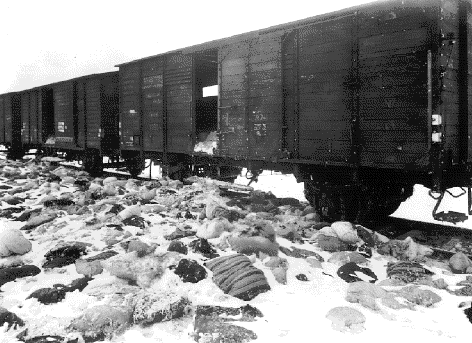
| View of the abandoned train in Auschwitz-Birkenau, Poland that was on the way to Germany loaded with the personal effects of Auschwitz victims. Some of the freight lays scattered and partially buried in the snow outside the train in February, 1945. Photo credits: National Archives, courtesy of USHMM Photo Archives |
"Harry Spiro, a survivor of the death march from Rehmsdorf, who was also liberated in Theresienstadt, recalled how the Russian soldiers told him that he and his fellow survivors had 'twenty-four hours to do whatever we wanted, even kill Germans. I don't think any of us actually did that. I'm not sure why. We were too busy looking for food, and relieved to have survived, but I also don't think it is in our nature to do that.' At that time, Harry Spiro reflected: 'I don't remember having any plans and I certainly didn't feel elated at having survived, since all my family were dead'."
Minia Munter had survived ten days in a death train before reaching Theresienstadt from a slave labour camp at Oderan, near Chemnitz. Shortly after liberation, she recalled: 'As we were lining up for the daily soup, after a couple of spoonfuls, I collapsed, bleeding terribly from my lungs. No one thought I could survive. I was put in a wooden bunk and given lumps of salt and calcium, which looked like lumps of chalk. I wasn't sent to the hospital because there were no beds available."
"Monick Goldberg, who was liberated in Therienstadt three days after his seventeenth birthday, was a survivor of the slave labour camps of Pionki, Buna and Krainkel. He recalled how, two days after liberation, 'two other boys and myself managed to get out from the Hamburger barrack into other parts of Theresienstadt. People were dancing in the street. I don't remember having any feelings of elation. I just felt I had to get away from there. We took to the road and it was a sight to behold. There were abandoned wagons and trucks all over the countryside. It was as if a tornado had swept through. There were people on the move. There were dead horses and some dead Germans. We rummaged through the abandoned caravans looking for food and some decent clothing. We found cigarettes, which were as good as money."
"We arrived in Prague after hitching rides with the Russians. I cannot find words adequate to praise the Czech people of Prague. We went to a hotel hoping to find a place to stay, prepared to pay with the cigarettes. They wouldn't hear of it. We sold some cigarettes for currency to be able to pay our way around. But wherever we went, to a restaurant, or to the cinema, or a concert, they refused our money. All they said was "Z Koncentraku" ("From a concentration camp") and refused to accept any payment. A family invited me into their home. I met a man who was from Libochevice and he invited me to come there to stay with his family."
"Kopel Kandelcukier returned from Theresienstadt, where he too had been liberated, to his home town of Bialobrzegi. With him were a few other survivors fro the town. 'We went back to Poland just in case there were any survivors from our families. The Poles were very hostile to us, and I was glad to get back to the safety of Theresienstadt."
"Roman Halter reached Chodecz, which he had last seen five years earlier, at the time when his parents had been deported to their deaths at Chelmno, and he had been sent to the Lodz ghetto. On reaching his town he went straight to his former home, in which a Polish family were living. 'I had the feeling they were going to kill me', he later recalled. 'They didn't want to give up part of the house'. Leaving Chodecz, he made his way from Poland to Czechoslovakia, and then, about seven weeks later, 'I travelled -- mostly on the tops of trains -- from Czechoslovakia back to the family Fuchs [farm], together with gifts of soap, coffee, sugar, and smoked meat, the profits from my black-market transactions. I thought I would surprise them with this gift of a few items of appreciation and thanks for having taken me in and hidden me during March and April 1945."
"Roman Halter's generous impulse was to come up against yet another harsh reality of the war years. 'When I arrived', he later wrote, 'I found Mrs. Fuchs all in black. Her face had aged by years in those few weeks since my departure from them. She screamed when she saw me and refused to speak. Her neighbour told me that a few days after I had left, the Nazis in the village had found out that the Fuchses had sheltered Jews in their home. They then went to the house and took out Mr. Fuchs, Szwajcer and Sztajer [two Jews sheltered]. Mr. Fuchs and Szwajcer were shot. Sztajer managed to talk himself out of it. Mrs. Fuchs dragged her husband's body back to the garden and buried him under a walnut tree. When I heard this, I left the provisions I had brought for Mrs. Fuchs with a neighbour and returned immediately to Czechoslovakia."
"Harry Balsam was nearly sixteen. 'About four weeks after the war', he recalled, 'my friend Pomeranc and I decided to go back to Poland to look for some living relatives, and at the same time to find the treasure that I had hidden when I was in Plaszow camp. At about seven o'clock my friend Pomeranc and I went to the station, because we heard that the trains were getting packed with survivors wanting to return to Poland. While at the other station we met some Jews who had just returned from Poland. We told them that we were waiting to go back home. They said that we must be mad to want to go back as they were still killing Jews in Poland We could not believe it and asked who was killing the Jews now, They told us the Poles were doing what the Germans could not manage, and that they had been lucky to come out alive from Poland. We got frightened. We were only fifteen years old at the time. So we returned to Theresienstadt and warned the other boys not to go back because it was dangerous in Poland."
The Boys -- Triumph Over Adversity -- The Story of 732 Young Concentration Camp Survivors : Martin Gilbert
Monday, November 9, 2015
The Children Who Survived
Michael Novice, who had been a slave labourer at Sosnowiec, Buna and Krawinkel, later recalled: "Unfortunately I was too sick to be able to get up and see the German guards being taken prisoner. The liberation was my salvation. Had the war lasted another week, I would not have survived. Once liberated, I was placed in a sick-bay. There, Russian army doctors and nurses nursed me. My health was so poor then that there was a period when the staff gave up on me, thinking that I would not make it."Also liberated at Theresienstadt was Pinchas Gutter, who had been deported three weeks after the Warsaw ghetto revolt to Majdanek, where his father, brother and sister had been murdered. At the age of twelve he had ended up in the slave labour camp at Colditz, and like Pinkus Kurnedz had survived the death march from there. After the liberation of Theresienstadt, Pinchas Gutter recalled, "We all rushed out and found ourselves on the main highway where a multitude of German refugees were being expelled, or fleeing to Germany. Families with children, peklach [parcels], with hand wheelbarrows, horse-drawn wagons, bicycles, were making their way and were being assaulted mainly by Czechs, some by Russian soldiers, and by very few survivors. I was with a band of children, and I remember very clearly my own sentiments of pity and commiseration towards these people, because they reminded me of my own suffering. I remember similar sentiments were expressed by my companions. After all these years I still find it intriguing that instead of an intense hatred which I should have felt for these people because they were Germans, all I felt was pity and commiseration."
David Kutner, originally from Lodz, was among those who reached Theresienstadt from Buchenwald. In the open wagon in which he travelled, often sleeping without realizing it on the bodies of those who had died during the night, he recalled how one day "we came to a stop in a siding, we were there for a few hours, and all of a sudden we realized that all the German guards had disappeared. By this time, I realized that my life, what was left in me, was ebbing away. I was delirious, and very feverish. I can vaguely remember being in some kind of makeshift hospital, where I was thoroughly bathed (my body had not been washed for months) and put into bed. I passed out, and when I came to, I was told that I was lucky to be alive, as I had survived a high temperature which is peculiar to typhus."
| Taken just after the liberation of the Auschwitz-Birkenau Nazi concentration camp by the Soviet army in January 1945, this photo shows a group of children in camp uniform. The girl holding out her arm, showing her ID tattoo, is Miriam Ziegler. (Associated Press) |
Those liberated after the death-train journeys were so weak that they could hardly eat. Great discipline was needed to avoid foods which the body could not absorb. After such long deprivation, not everyone could restrain themselves. "As a result", David Kutner recalled, "it was very distressing to see many of my friends die from simply eating -- having survived the six years of terrible experiences, concentration camps ... "
Arek Hersh was sixteen when the Russian troops reached Theresienstadt. Like many of the boys, he had arrived there only a few days earlier from Buchenwald, after a four-week ordeal. "We all looked alike, our bodies just skeletons", he later recalled. "The six of us who shared the room -- Jankl, Natek, Yacob, Moshe, Berek and myself -- went to bed that evening utterly exhausted, but it was not long before I was woken by a commotion coming from the streets. I heard people shouting and I went to the window to see what was going on. The sight that met my eyes was of people trying to climb on to a tank, several jeeps nearby filled with Russian soldiers, and hundreds of people running towards them. I saw a soldier playing an accordion while others danced."
"I saw many boys of about my own age in German uniforms, walking towards the assembly camp. At the end of the war the Germans in desperation had been making boys of fifteen into soldiers. Watching the Germans pass by, it was hard to believe that this dishevelled rabble were the soldiers of whom we had been so terrified. They must have been wondering what the Russians would do to them. Everybody knew how the Germans had treated the Russian people when they invaded Russia. I thought, "Surely the Germans can't expect any mercy?" I thought of the millions of Jewish people they had tortured and slaughtered, and I wondered what punishments would be meted out.
"As we watched, a young German boy of about my age stopped in front of us, took a knife out of his pocket and silently handed it to me. It was a Hitler Youth knife with a swastika on it. We looked at each other, neither saying a word, then he turned and walked away. Even then that moment seemed poignant to me, and I turned to Moshe and said how happy I was that we had lived to see this day. Clutching the knife and the food we had taken from the SS officers, we made our way back to the camp at Theresienstadt.
"The Russians gave us twenty-four hours to do whatever we wanted to the Germans, but being human beings we did nothing. On arriving back at Theresienstadt we noticed two cauldrons of rice pudding. I brought out the knife the German boy had handed to me and ate my share of rice pudding ravenously. I thought of my beloved parents, of my dear brothers and sisters, and of the many relations and friends who had lost their lives. I prayed for their souls and I prayed for myself."
The Boys -- Triumph Over Adversity: The Story of 732 Young Concentration Camp Survivors compiled by historian Martin Gilbert, copyright 1996
Subscribe to:
Posts (Atom)