Wednesday, February 14, 2018

It is nothing short of ghoulishly disheartening that a country which advances itself as civilized in this, the 21st Century, is culturally comfortable with a flourishing market for dog meat. It boggles the mind that any humane culture could conceivably feel at ease with raising all manner of dog breeds for the express purpose of slaughter for the human table.

According to Humane Society International there exist an estimated 17,000 "dog meat farms" across South Korea. The nation that is now the centre of attention for hosting the 2018 Winter Olympics that has extended yet again the hand of conciliation toward North Korea, eliciting admiration far and wide, and even in its warming outcome with its sister-nation seeing a fallout of instantly faltering memories of North Korea's totalitarian brutal regime, is no less brutal itself in its devotion to raising dogs for human consumption.


In some of these "dog farms", dogs are kept individually in small cages reminiscent of caged poultry on farms elsewhere in the world.  The dogs are raised in those cages and slaughtered, their butchered remains sold in markets and to dog meat restaurants. In the city hosting the Olympic venues for skating and hockey there are a dozen dog meat restaurants. The stews and soups produced are held in great esteem, believed to be beneficial for healing the body and for their purported virility-enhancing qualities.

An estimated two and a half million dogs are killed each and every year in South Korea, to be eaten by enthusiastic culinary aficionados. The charity Humane Society International has an intense presence in South Korea, hoping to be able in time to eventually close all of these "dog farms" whose residents are dogs of all breeds, anxious for a humane touch, curious about people who may pass by. On the other hand there are those dogs which have been so brutally beaten then shrink back in fear at the sight of a human.

The owner of these dogs says his operation started with just one animal, but then grew too big over the 10 years it’s been in operation.
The owner of these dogs says his operation started with just one animal, but then grew too big over the 10 years it’s been in operation. Reid Fiest / Global News

The charity approaches dog farmers offering start-up grants if they agree to close their dog-slaughter business and begin anew, focusing on another industry other than the one in which large-breed dogs, valued for their size and the concomitant amount of flesh to be had with their slaughter,  cannot even stand erect in the cramped cages they are forced to live in. There are golden retrievers, white Grand Pyrenees, Jindo mixes, Korean Dosa Mastiffs -- and small breed dogs cowering in fear at the back of their cages.

"We can't stop this industry one dog meat farm at a time", stated the executive director of HSI, given the enormity of the presence of 'farms' and the clamour by the public for dog meat. Those they are able to close, however, shine "a global spotlight on the dog meat trade" and the charity's work offering the government of Korea "an economic model ... to follow when it makes the decision to end the dog meat trade".

Alice is shown locked in a cage at a dog meat farm in Namyangju, South Korea in fall 2017.
Jean Chung / Humane Society International

Tuesday, February 13, 2018


Odd, how fewer people seem to be coming through the ravine of late. We're on the downside of winter, so the daytime highs seem to fluctuate around -6C, and we're enjoying many days of full sun -- and we can actually feel the warmth of the sun if we're momentarily in a micro-climate of shelter from the wind -- alternating with dismal days of freezing rain mixed with snow and ice pellets, but the atmosphere doesn't feel as though there's a warming trend, not yet.


Could be the awkwardness of tramping along on trails layered with ice over the thick snowpack is uncomfortable for people not accustomed to hiking along forest trails. We do on occasion come across old familiar faces. And just a few days ago we came across tiny Daisy whom we hadn't seen since the winter before. She's half the size of our two scamps, and wasn't fazed by their obstreperous behaviour. At seven years of age she has undoubtedly witnessed more than her share of silly canine behaviour which she, lady-like, deigns not to dignify.


Yesterday's hike took place after I'd spent hours cleaning the house, so I wasn't feeling too dreadfully physically ambitious. Once out in that ambiance, however, tiredness seems to slip away and you just stride along, appreciatively observing the landscapes as you pass one after another. Appreciating also the humorous tactics Jackie and Jillie employ to challenge each other to heights of adventure. Jackie in particular is given to suddenly racing off in a frenzied spurt of happiness, sometimes enticing Jillie to join him and then we just stand there, gaping at them until their excessive lunacy passes.

Button used to go into ecstatic phases of happiness, and would race toward me from an ample distance, and when she approached where I stood would launch herself into a long, graceful leap directed unerringly at my open arms, and I would catch her, and snuggle her in my arms, congratulating her for her physical feats of acrobatic perfection.

Monday, February 12, 2018

The steel canopy that my husband erected over the deck, replacing the previous canvas types that we had used for many years, has its benefits and its setbacks. The canvas ones had to be taken down overwinter and hoisted back up in spring, and they lasted a few years before succumbing to wear and tear, and the steel-topped one doesn't require replacement and nor must it be removed in the winter.

The canopy affords us some protection from the extreme heat of the summer sun, enabling us to sit out comfortably and relax on the deck with our puppies. And it also serves an invaluable function in keeping the interior of the house cool where we enter the house from the deck into the breakfast room and beyond into the kitchen.


Except -- there's always an 'except', isn't there? -- for the fact that its weight-bearing capacity has its limits. Given that indelible fact, we now feel it wasn't all that great a decision to erect it on the deck. Since we've got a raised deck, the canopy sits a considerable height off the ground. So how to clear it of snow? Each time the canopy bears an accumulation of snow over six inches in depth it's supposed to be cleared off. Particularly in the knowledge that more snow will fall, thickening the load, increasing the opportunity for a collapse.


Yesterday the canopy boasted eight inches of snow. And the forecast was for freezing rain to begin in the early afternoon and to continue the remainder of the day. That snow with an additional burden of ice pellets would constitute an enormous weight. We've tried to think of alternatives to my husband, at age 81, mounting a ladder and scraping the snow off the canopy with the aid of a long-handled brush. Yesterday morning he went off to a local hardware store that had been advertising roof rakes. And he came back with just that; a well-designed shovel/rake with a long handle that included snap-on parts to lengthen its reach.


And it worked very well indeed; no ladder perched precariously over frozen layers of ice and snow on the ground to clamber up to reach the snow-and-ice-laden metal canopy roof. Just what the doctor ordered, so to speak. My anxiety quotient plummeted. The canopy was cleared nicely, and then the freezing rain came down, littering the environment with frozen bits of ice and snow.


Sunday, February 11, 2018

Driving on area arterial roads, or for that matter anywhere within the city, you get an appreciation of just how the extreme weather conditions that exemplify an Ottawa winter challenge the integrity of asphalt surfaces. Yesterday when we drove along the Eastern Parkway to reach the Byward Market in downtown Ottawa, the road surface was so disturbed a drive that is usually fairly smooth was instead continually reminiscent of what it's like to drive on country gravel roads.

The constant winter freeze-and-thaw cycles wreak damage everywhere, from producing large cracks across roads, to deep potholes. We drove along ongoing ridges created when those freeze-and-thaw events serve to separate road surfaces from their original integrity. It's impossible to make such a drive without being very conscious of road damage, aside from the fact that alertness is required to avoid if possible any potholes that could pose a damage threat to vehicles.

Of course municipalities coping with weather conditions by spreading salt everywhere for safety reasons add to the damaging effects, not only on roads, but other surfaces, as well as buildings and vegetation which salt-spray also damages, not to mention one's own garage floor where salt brought in on tires produces the inevitable deterioration there. To avoid rust resulting from these winter efforts at safety conditions, we've been having our vehicles winter-oil-sprayed for years, otherwise within a few winter years vehicles become proverbial rust-buckets.

After our ravine walk with our two little dogs yesterday, we drove to Byward Market for our usual expedition for art and antique publications, specialty cheeses and bread products from the incomparable Rideau Bakery that continues to produce the bread products we've been familiar with and vastly prefer over commercial products pretending to be bread, since our childhood.

It was snowing lightly when we were in the ravine, not too cold nor windy which made for an exceedingly pleasant hike through the snow-invested forest. As we drove along the Eastern Parkway, there were some good views of the mighty Ottawa River that bisects Ontario from Quebec. Some open-water areas where the local water treatment plant emits warm water into the river, and where the rapids are located; otherwise it is ice-and-snow-covered, a great wide, long expanse of white.

In fact, the entire landscape appeared white, a pale opaque ice fog enveloped the area, giving a muted aspect to everything, shaded in white. The shop we frequent for magazines and newspapers carries every conceivable single-interest type of publication, and we've gone there for many years. They also sell tobacco products discreetly, even more discreetly Marijuana appurtenances. The store is owned and operated now by an patrician-in-appearance Somali man, courteous and helpful.

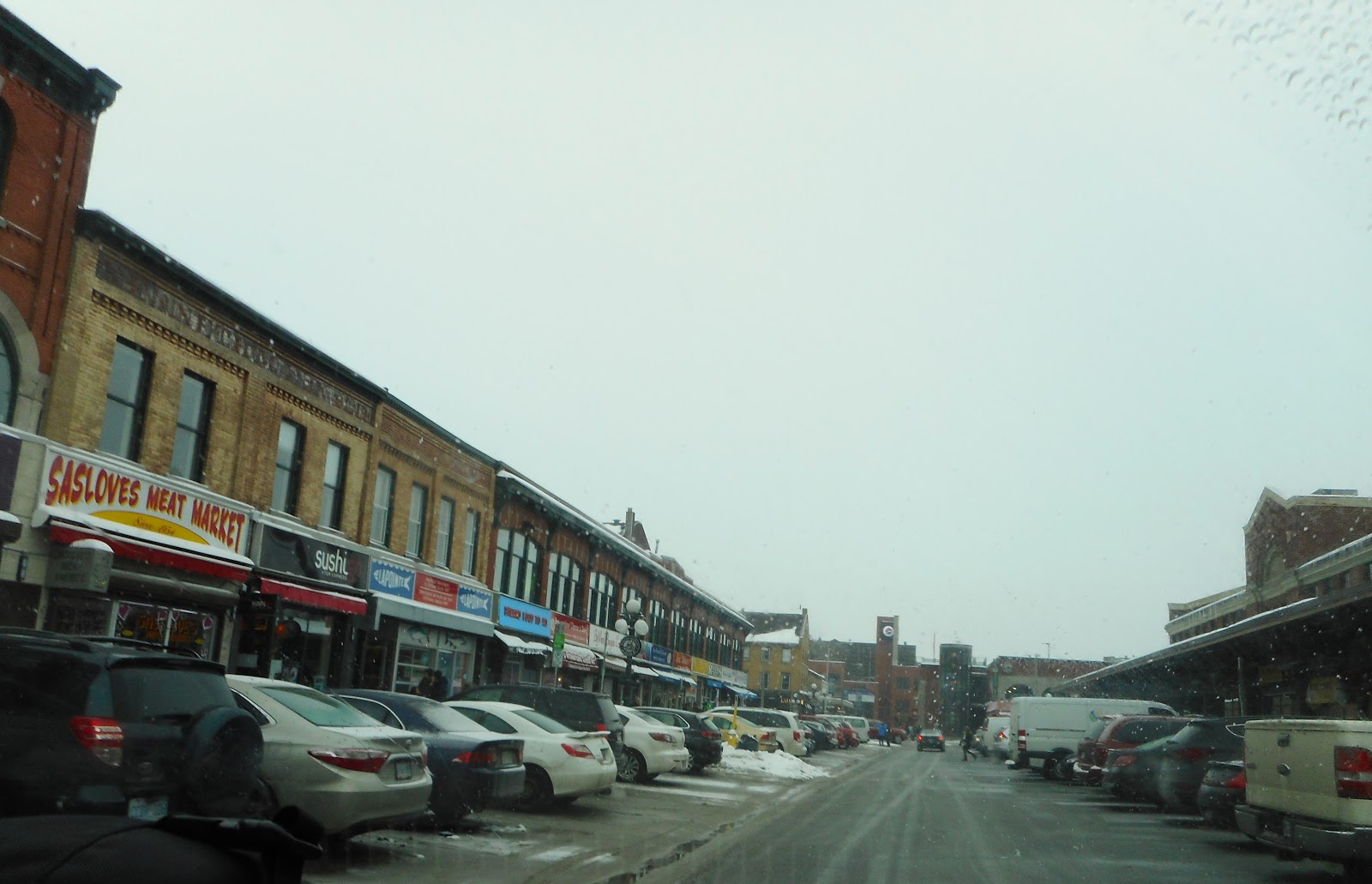
All of the usual stalls selling produce, plants, handicrafts, exotic imports and other items that appear from spring to summer to late fall are absent at this time of year. Which makes for more parking spaces available for shoppers meaning to access the many little boutique-type shops selling cheese, meats, fish, produce and other products, along with a multitude of cafes and restaurants and bars. Although there aren't the crowds one sees during the spring and summer and fall months thronging to the Market area, there are still ample numbers of people striding along the streets that comprise the area; a magnet for tourism and locals to congregate.

Saturday, February 10, 2018


Dogs have a cheerfully unerring memory for certain things. They instantly recall on sight (augmented by a giveaway smell) those who in the past have indulged their appetite for treats. A certain method of attaining a friend-for-life; transforming a dog one has hitherto been unacquainted with, is to offer something palatable to its canine taste. That could be almost anything with some dogs, but all dogs appreciate those playful little tidbits that come in little packages labelled "dog treat".

Some dogs are so fixated on edibles that on first meeting they are far more interested in what might be discreetly contained in a pocket than coming face to face with the person wearing the pocket. I've had large dogs nuzzle me companionably, only to discover they've managed to get their snouts successfully into the bag of doggy treats that accompany our walks in the ravine.

Now that we're all geared up to withstand the (scrambled eggs, oatmeal cereal, fresh vegetables and fruits) that we're sparing with the dog biscuits with them.
cold and wind every time we venture onto the forest trails, it's my husband who reaches into pockets to retrieve bags of treats. And he does this regularly whenever we come across dogs other than our own. Our own two little rascals get so many other kinds of special food treats, from sharing elements of our breakfasts and dinner preparations

But they know that when doggy cookies are being handed out, they'll be included, so the enthusiasm is spread about, all dogs present clamouring to be noticed, nudging knees and hands with anxious snouts so as not to be overlooked in the general melee of the moment.

And so it was yesterday during our afternoon ravine ramble. Light flurries under an aluminum-coloured sky almost perfectly reflecting the prevailing shades of snow billowing on the forest floor, now and again a wan attempt by the sun to burn through the metal cap of the sky -- almost succeeding but yet not quite. A beautifully moderate-tempered day of -2C brought plenty of people from the surrounding community out to share the leisure pleasure of a stroll through woodland trails, and we made it last as long as we could, taking an especially long circuit before finally heading back home.

Friday, February 9, 2018

In the evenings, sometimes from our backyard we can hear an owl in the distance, calling from the forest in the ravine up the street from our house. There was, one winter, an influx of great grey owls and snowy owls in this area and we came across the great greys in the ravine from time to time at fairly close range. Some even nested in the ravine and sometimes we saw two generations together. They were driven from their winter homes north of us by a scarcity of food. In the ravine they found ample small wildlife to feast on.

In the mornings now, we occasionally hear cardinals, those marvellously scarlet-plumaged birds with their exquisitely beautiful songs. They tend to remain in the area as long as they can find food. Crows have returned to the ravine, we can see them wheeling high above the treeline from our front door. Yesterday, from the site of Riverside Hospital in west-end Ottawa, we saw a murder of crows lifting off from nearby bush in the near distance.

A few days ago we heard a pileated woodpecker thrumming on trees in the forest. Before long, migrants will begin returning to our area, and we'll be excited to see them. We haven't seen too many birds at all, other than the occasional glimpse of nuthatches and chickadees in the ravine this winter. Soon, I believe, we'll be seeing robins, but it's been a hard year for birds in this area with too many prolonged periods of extreme cold.

On our ramble through the woods yesterday we saw no birds. We did see some people walking along in the distance on trails below and beyond those we were on. One Golden Retriever, feeling particularly friendly, left one of the far-off trails in great loping strides to come abreast of us for a sniff-about, before returning to its companion.

It was a sunny day, but cold and windy. The thermometer reading fooled us with its false reading that must have been reflecting direct sun contact. We failed to put boots on Jackie and Jillie and the result was that though it wasn't all that cold on their little paws, the conditions of freshly fallen snow plus the cold added up to ice build-up on their paws making them very uncomfortable from time to time, necessitating that we peel off the ice occasionally on their underpads. Under those conditions we'll remember not to make that mistake again.

But it was exceedingly pleasant out on our woodland hike regardless. We're on the downside of winter and that's a useful thing to remember when we're feeling tired of the cold conditions. In the meantime, we've got glorious landscapes to admire and ramble through and make the most of before winter prepares to depart.

Thursday, February 8, 2018

The penetrating cold exacerbated by biting winds that winter days can bring never bothered us back when we were young/younger. Which is to say we were able back then to maintain a fairly brisk pace trudging about on the snow-packed trails of the forested ravine. Decades ago. Faster, further, utter lack of fatigue.

We think our pace is fairly brisk, still. And then we walk awhile with younger folk and realize that on the ascents their pace is steady and ours tends to lag. In actual fact, I've found that when we're with others we tend to pick up our pace to match theirs and don't, in the process, feel any the worse for it. When we're together without anyone else about we take our time, and that really works best for us.
Steady as she goes is us.

We saw no one else out and about in the ravine yesterday. It was quite cold at -14C, but we escape the worst of the winds when we're in the ravine. It's when we trudge uphill to attain the higher flat portions when the wind sends its probing icy fingers through the forest canopy and more open areas where the main trails tend to be much wider.

Jackie and Jillie take no notice of any of these details quite irrelevant to their experience. Wearing those little protective booties over their tiny feet makes quite the difference for them. They don't seem to be aware that their feet are restricted in these tight little rubber things, but they do seem to react as though they've been spurred to action. That action takes the form of madcap races and leaps and pirouettes as though they're teaching a class of squirrels the requisite acrobatics to skip from branch to bough.

When we arrive home and hastily remove the boots, conscious of the restricting element and aware that we don't want to cut off their circulation, their feet are clean and warm. Otherwise, after new fallen snow they pick the snow up in between the interstices of their pads and every step compacts the snow, the heat of their body turning it to ice as they pick up new layers until their pads are packed with uncomfortable lumps of ice.

They will attempt themselves to bite the ice off, usually to little avail. Because of their obvious discomfort we pick them up from time to time to peel away the accumulated ice. And the process is repeated. Seems infinitely more practical to avoid all of that and pull those little rubber booties on.
When the temperature isn't too cold, that becomes an option. When it plunges to -20C, the boots are a necessity.

Despite the cold we felt fairly toasty, having ourselves worn layers upon layers under our winter jackets. We'd miss too much if we hesitated to venture out to the forest for a daily walk, due to the inclemency of the weather. It always seems so much more cold, icy, windy and harassing out on the street. Once we're in the forest striding along the trails we feel partially cocooned in nature's more gentle of moods.