Yesterday, in the ravine we came across a young woman whom we see infrequently, walking her little white Shih Tzu dog, an inoffensive little fellow, in the ravine. I greeted her, then continued on, but my husband who is often far more sensitive to people, and in any event, more geared than I am personality-wise to listening and empathizing, stopped to speak with her, sensing she was upset about something. She had a story to tell. And it wasn't a very pleasant one.
Back in early March she had been walking along the trails in the ravine, when suddenly she came abreast of five large dogs, unleashed and obviously rushing ahead of whoever was walking them. They surrounded her little dog, intimidating it, so instinctively she pushed them back and reached over to pick her little fellow up. Most of the dogs retreated, but a large Doberman did not. That dog kept trying to get at the small dog cradled in her arms.
Try as she might, she was unable to completely protect her little dog and it sustained some serious bites while she tried to fend off the large dog, still holding hers. The person walking the dogs had by then caught up with them, and rushed over to pry the Doberman's jaws apart, to release the little dog in the grasp of its owner. He then called off the Doberman, apologized for any 'inconvenience', and walked off with the dogs in his care, while she and her small dog were left in obvious distress.
She rushed the little dog to the veterinarian hospital she uses, and the vet there, examining the injured dog, said he'd never before seen such severe bites sustained by a dog. The dog underwent urgent surgery to repair its wounds and eventually recovered. The man, she wanted us to know, was someone we were familiar with. And indeed he was.
We had met him for the first time three winters back when he had come by a rescue dog, a female black Lab that was not yet a year old. He seemed like a very nice person. Rough-hewn, tall and angular, with a thick Cockney accent, he told us how much he related to dogs, he thought he had a special talent for understanding and communicating with them. Our two little dogs certainly agreed with him on that score.
He had worked all his life as a roofer, a tough job, and he was sick of it, prepared to try something new. And that something new was to veer toward dog training and dog walking, hoping he could make a living with it. He found plenty of people who hadn't the time or the inclination to walk their dogs and were eager to take advantage of the service he offered. We would see him occasionally in the ravine on our walks, walking a number of dogs, some of which were regulars, others newly joining his walking pack. He told us he goes out several times a day with various dogs. He appeared to have them well under control and was anxious to give them the freedom to move about off leash, in the ravine.
After the event the young woman described to my husband, she contacted him on line to inform him that it had cost her two thousand dollars in medical fees to rescue her dog from the damage done to it by a dog this man was walking as a professional. She asked that she be, at the very least, reimbursed. He told her he hadn't the money, and I doubt he was not being honest about that.
She could sue him in Small Claims Court, but she isn't interested. She's just grateful her little dog survived, and puts the event down to a lesson learned that bad things happen when one least expects them to. My husband feels vindicated in a sense; he had never warmed to, nor felt this man could be trusted, while I had the opposite impression of him.
Wednesday, April 26, 2017

Tuesday, April 25, 2017
Finally, proof-positive that spring, though tardy, has finally arrived. Since we were expecting more rain, we took the initiative to leave for the ravine in the morning, while the sun was still out, the temperature slightly more forgiving than it had been yesterday. Enough so that even though it was windy, it was still not as cool as yesterday, though we both still needed gloves to keep comfortable.

We were surprised to find another delightful discovery. In yet another place where we'd never before seen the earliest of the spring wildflowers in bloom, there they were, a nice, bright patch of sunny coltsfoot. Our little dogs weren't much impressed, but we were.

We also saw hazelnut bushes beginning to send out their earliest of bright red, minuscule flowers, and the early-blooming honeysuckle shrubs are full of tiny, bright-green leaves. And, looking up and above, toward the forest canopy framed by the still-blue sky, there we could see buds on the poplars and maples. In fact, as we walked further along the trails, we saw the first of the tiny red flora that maples tend to drop in the early spring.

Perhaps the biggest surprise of all, though, was that the interior of the forest floor was erupting with trout lily foliage, so the bright, shy, yellow flowers shouldn't be too long in blooming. Since we saw the trout lilies coming up, we sharpened our vision for the very first glimpses of trilliums coming out of the damp soil, and sure enough, not yet fully displayed, but on the verge of it, were a number of early-early purple trillium leaves and stems; the flowers won't be far behind!

Monday, April 24, 2017
Not much to look at yet, but it's a start, in the gardens. All the rain we've been receiving and the days of full sun that invariably follows, have encouraged all growing things to present themselves above the winter-tired soil. The first of the grape hyacinths are beginning to bloom, modestly but much appreciated for the tiny bit of colour they treat us to.

We had wonderful weather yesterday with full sun, not a cloud in the sky and a warm atmosphere, so unlike the day before. The temperature heaved itself all the way up to 18C yesterday and we made the most of it. My husband spent hours outside, de-thatching the lawns, raking them, collecting winter's debris, and finally fertilizing. And our ramble in the ravine was restful and comfortable at that temperature when even the wind seems like a balmy kiss of nature.

Today, again, a clear blue sky and a warming sun, though we've lost about eight degrees of warmth. Who could possibly complain, though? Today my husband set himself the task of liberating all of our garden pots from their collection point and the tarp that covered them. He set them all in place in anticipation of planting them with colourful annuals within the month, and cleaning up all the dropped soil from where they stood, to shovel it into the nearby gardens.

Everything is beginning to take on a hopeful, neat and tidy aspect, as though even our personal landscape is eagerly anticipating summer, colour, texture, fragrance, freedom.
Some of the peonies are beginning to poke their bright pink shoots out of the ground. The lilies and the irises had a head start, and the heucheras seem to recover as soon as the snow recedes; but now other perennials like bleeding hearts, Canterbury bells, bluet and Ladies Mantle have begun to erupt and even a few of our treasured plantain lilies (hostas) are beginning to sprout from the soil. Each new sighting is exciting for the prospects of the garden coming to full flower.
Our magnolia trees' flower buds are beginning to swell and it won't be long before their blossoms open. The same for rhododendrons and roses. I can hardly wait.

Sunday, April 23, 2017
Although yesterday was a miserable, cold and windy, heavily overcast day for a change when we strode into the forest and down into the ravine, there we came across, through our hour-and-a-half foray along trails that were now so heavy in muddy clay they were the worst we've yet seen this spring, many people out on the trails with their dogs.

We knew, walking up the street, that though the forecast was for an improvement over the day before, it was not an atmospheric-conditioned day to make us celebrate. The only positive thing that could be said, is that no rain was in the offing. The already-saturated woods could hardly take any more. And as soon as we entered we could see that the trail directly behind the houses on our street which we rarely take in any event, had been closed off with tape and warning signs.
 A municipal truck had been parked within the ingress to the forest, and that was adequate proof that local authorities who look after the city's extensive park system as well as the wilder portions such as we enjoy are alert to the dangers posed by the recent landslides that have resulted from saturated conditions in the ravine, denaturizing the Leda clay deposits in the soil.

But our little dogs didn't care, they are just interested in sniffing and snuffling about everywhere, coming in contact with other dogs out doing likewise. These new conditions that have altered the layout of the ravine in certain places, however, are the literal 'talk of the town'. At least that portion of the 'town' that is localized and of interest to the small percentage of residents who value and make use of the Bilberry Creek Ravine forest.

No new slumps appear to have occurred since our sightings and hearings of yesterday afternoon. But it appears that beavers have taken advantage of the large pooled areas that have arisen where the creek has been stopped up, and unable to take its usual direct course of flow. Which means, if they're allowed to remain there in new territory they've claimed, more poplar trees will be taken down to add to the many they've already harvested.

Some people we came across spoke of one fellow's experience when his Golden Retriever did what all of that breed loves to do; entered the creek at a point not too far distant from one of the beaver dams, and was surprised to have a beaver underwater swim toward the dog and snap at its chest. The dog had to be rushed to the veterinarian hospital for immediate surgery, but he'll be fine.

When beaver feel their immediate territory is being threatened, or when they've been cornered they can be pretty fierce in looking after themselves; those front teeth that make quick work of tree trunks are capable of a lot of damage to tender flesh.


We knew, walking up the street, that though the forecast was for an improvement over the day before, it was not an atmospheric-conditioned day to make us celebrate. The only positive thing that could be said, is that no rain was in the offing. The already-saturated woods could hardly take any more. And as soon as we entered we could see that the trail directly behind the houses on our street which we rarely take in any event, had been closed off with tape and warning signs.


But our little dogs didn't care, they are just interested in sniffing and snuffling about everywhere, coming in contact with other dogs out doing likewise. These new conditions that have altered the layout of the ravine in certain places, however, are the literal 'talk of the town'. At least that portion of the 'town' that is localized and of interest to the small percentage of residents who value and make use of the Bilberry Creek Ravine forest.

No new slumps appear to have occurred since our sightings and hearings of yesterday afternoon. But it appears that beavers have taken advantage of the large pooled areas that have arisen where the creek has been stopped up, and unable to take its usual direct course of flow. Which means, if they're allowed to remain there in new territory they've claimed, more poplar trees will be taken down to add to the many they've already harvested.

Some people we came across spoke of one fellow's experience when his Golden Retriever did what all of that breed loves to do; entered the creek at a point not too far distant from one of the beaver dams, and was surprised to have a beaver underwater swim toward the dog and snap at its chest. The dog had to be rushed to the veterinarian hospital for immediate surgery, but he'll be fine.

When beaver feel their immediate territory is being threatened, or when they've been cornered they can be pretty fierce in looking after themselves; those front teeth that make quick work of tree trunks are capable of a lot of damage to tender flesh.

Saturday, April 22, 2017
So yes, after we managed to get out yesterday in a break between rain events, rain began once again on our return home from our daily ravine walk. The forest has an amazing capacity to absorb water, but even it has its limits. The deep winter freeze-up of the forest floor has finally been released to thaw, and the absorptive capacity of the forest thus has increased. Even so, there are numerous pooled areas in the forest making it resemble in part, a mini-bayou, a mess of swampy places where it is best to avoid venturing.

For the most part the trails remain accessible, although very mucky. The landscape looks dreary, but that is normal for this time of year when colour tends to be on the dark scale of the spectrum, all the more so when heavily overcast skies prevail. And the skies have been heavily overcast, and they have also emptied their contents copiously on the environment below. Causing flooding in low-lying areas and consternation when entire streets come under water.

For the forested ravine that we so much depend upon for our leisure exercise and exposure to nature that we so much value, all that excess moisture -- and this year it truly is 'excess' -- causes a natural phenomenon to occur that also comes into play when an earthquake -- to which this area is also inclined -- occurs. The soil base, Leda clay and sand, is affected under these unusual weather circumstances.

The base of the forest floor and deep within it becomes denatured in a sense, as the Led clay, completely saturated, becomes dangerously unstable. It has a tendency to liquefy, as it were, to completely lose its cohesiveness, and to disintegrate, sliding away, taking with it whatever stands upon it, in a huge slump resembling a miniature landslide.

When we first entered the ravine for our walk yesterday we noted immediately that to our right, at street level, the hillsides bordering and back of the homes on that side of the street had been involved in ongoing slumps, as a result of the excess of rain we've been exposed to. Trees leaned over here and there, having slipped from their moorings, on the cusp of falling into the ravine below. We knew a large slump had occurred further to the right a few days back but hadn't ventured to check it out, after being informed by neighbours whose houses are located down the street from ours.

An hour later, almost through our daily circuit in the ravine and again close to that area, we became aware of a sliding rumble, and the accompanying crack of trees. The sound arrested both us and our little dogs who found it alarming. It was indeed fascinating to hear, and it repeated several times. This time we ventured closer to where the slumps were occurring, hiking up a coll between two valleys in the ravine, on one side looking over to the hillside behind the houses where the slides were occurring. And we saw quite a mess.

The clay had separated, and huge areas of sloping forest had descended into the ravine below, some of it landing in the creek, which suddenly found itself blocked off from its normal flow pattern. Water always does find its way eventually, and further downstream we had earlier noted the widening of the stream, deep with mud-infiltrated flow. It seems that the inundated Leda clay will continue to deteriorate as long as the rains persist, and slowly alter the geology of that portion of the ravine.

The assumption is that what is occurring there, behind the street we live on, is also occurring elsewhere in the quite lengthy forested ravine, where the layout of the landscape is similar to the area close to us. Over the decades we have seen previous such instances of land collapsing from hillsides into the valleys below in various parts of the ravine. The circumstances of the elements collude to make landscape alterations that we feel are significant, but to which occurrence nature merely nods.


Friday, April 21, 2017
This has been quite the spring so far. We've had an enormous amount of rainfall. This, on top of the fairly large snowpack that had accumulated over the winter months, evidence of which can still be seen lingering on the trails in Bilberry Creek Ravine forest, and beyond, on the slopes of the forest floor.

Needless to say all that meltwater and rain has to go somewhere, and go it does, into the creek nestled deep in the ravine, running high and wide. When we went out yesterday for our ravine walk the creek was high but it was also extremely muddy. This, attributable to the fact that a ravine-walking acquaintance who lives at the foot of our street and whose house backs on the ravine informed us that there had been a massive slump over the weekend.

That means the high portions of the forest overlooking the ravine had suffered a bit of a slide. Hardly surprising, since the forest floor and deep within is comprised entirely of Leda clay and sand. When Leda clay becomes completely inundated, it tends to be slippery and entirely loses its compactness; it dissolves, in other words and collapses.

There was so much rain over Easter weekend, compounded by countless heavy rain events previously and more that came down and continues to come down, since. We had a break yesterday; although the sky was impenetrably dark with clouds and it was a windy, cold day, the rain held off. By midnight last night it came down, heavily, rained all night and on throughout the entire morning.
A much-appreciated halt to the rain arrived in early afternoon and that's when we seized the opportunity to get out for a walk with our two little dogs. They even got the chance to meet up with a few of their ravine friends and have a bit of a romp together.

And then we came along to the end-point in our usual ravine circuit, to see evidence of another hillside slump. Up on the hill, close to the street on which we live, there is a trail that runs behind the houses that back onto the ravine. It is from that trail downward where the slides appear to have been happening. This was a smaller slide than the one that had been described to us which was about a hundred feet wide. But we could see from this smaller, latest one that the creek had been filled with the collapsed clay, and the trees the fall had taken out, forcing the water flow to find its way through the roots of a fallen tree that partially blocked its passage.

Thursday, April 20, 2017

Two rivers run through or alongside the City of Ottawa; the Rideau River and the Ottawa River, with the former emptying into the latter. The Ottawa River is long and wide, a powerful river that swells and rises in the spring (and eventually empties into the St.Lawrence River). And that's what it has done this spring, rising higher than it normally does, a result of the spring run-off of melting snow and ice. Great ice pans wash down from the north, floating along the Rideau River until it meets the Ottawa at Rideau Falls. The Ottawa River runs behind and below the Parliament Buildings of Canada, the river separating the Provinces of Quebec and Ontario.
This past Easter week-end, 30 mm of rain fell in the area, raising the height of the Ottawa even more. And all-day rain events have since continued and more is expected in the near future. Yesterday, rain fell steadily and heavily, so we were locked out of our daily ravine walk, following on a perfectly sunny day just the day before. Areas close to the river are now in flood mode, and residents claim the river's rise and resulting floods are the worst they can recall in decades.
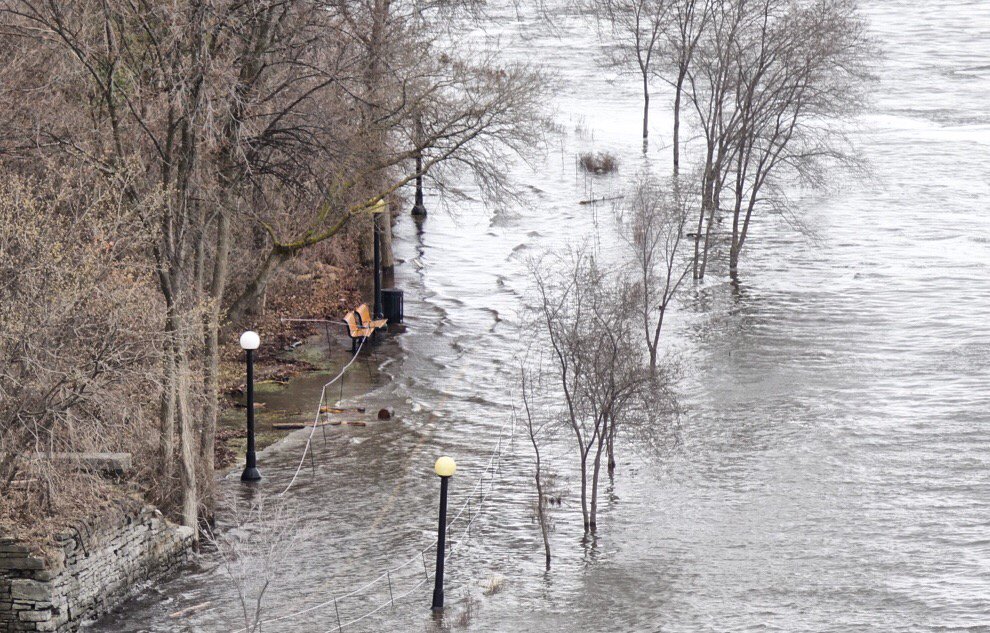 |
| Path alongside the Ottawa River, below Parliament Hill in flood. Photo, Ian Black CBC weatherman |
There are streets that tend to flood in such conditions closer to where we live, as well, but certainly not to the extent that residents of Gatineau in Quebec, just across the Ottawa River from Ontario are now experiencing. The city of Gatineau has been making sandbags available to residents who want to use them to hold back the floods that have engulfed streets and move steadily up driveways toward home basements. People are understandably anxious.
Yet their homes in most cases are built alongside the Ottawa River. In the winter this gives them handy access to the frozen river to enable them to carry on the beloved tradition of ice-fishing; setting up ice-fishing huts on the river ice, cutting a hole in the ice and spending hours in the huts on beautiful winter days, their fishing line through the ice, occasionally hooking a fish. But when spring arrives there's a rush to haul the huts to dry land, as the ice melts and the river level rises. Present-day municipal law should restrict building on flood plains, since it makes good sense.

But people tend to enjoy living close to large bodies of water, not only in the nation's capital, of course, but in places the world over where lots considered location-premium and pricey entice them, so they can build in close proximity to lakes or rivers with the assent of municipal bylaws. It's why during times of extraordinary storm conditions or spring melts catastrophic flooding occurs and people's pride of ownership turns to distress over the environmental and home ownership damage certain to ensue.

Subscribe to:
Posts (Atom)